Home
Museums
Back Issues
Membership
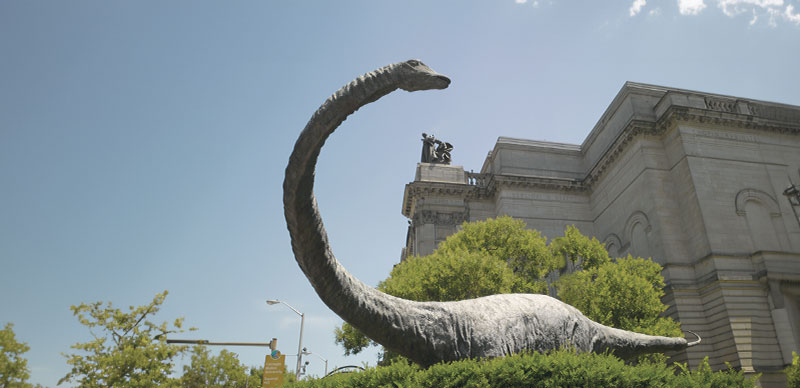
Fascinated by dinosaurs? Join the clubthe Dippy Kids Club, that
is.
Kids ages 3 to 12 are invited to become members of a new club devoted
to Dippy, the museums most famous dinosaur. Membership is free.
Members receive a poster of Dippy, dinosaur activity packet, and membership
card.
Show your card each time you come to the museum for a special Dippy
badge and sticker that signals your participation in the club. You may
name special adults as honorary members, too.
Every month a newsletter will arrive in your mailbox and by e-mail if
youre online. the newsletter will arrive by e-mail as well). And when
you click onto the museums web page, you will find special activities
for Dippy Kids Club members only.
Dippy Kids Club members will receive invitations to a special Dippy
Birthday Party in July. Come for the colossal cake and the chance to meet
museum paleontologists.
Be sure to sign up for the Dippy Kids Club next time you visit the museum.
Dippy Facts
The bones of Diplodocus carnegiiso named because Andrew Carnegie
funded the paleontological “dream team” that searched for its boneswere
unearthed in Wyoming beginning in 1899. Shipped to Carnegie Museum in 130
crates, Dippy went on display in 1907 and was the first dinosaur skeleton
in Dinosaur Hall.
Length (head to tail): About 88 feet
Weight: About 10 tons
Diet: Herbivore
Habitat: Land
Dates: 147 to 137 million years ago
Skeletal Features: Dippy was one of the longest dinosaurs ever. He had
a short body with long flexible neck and tail.
Dippy had very weak teeth in the front of his mouth, and no
chewing or grinding teeth in the back of his mouth. He may have swallowed
stones to help grind up its food.
Powdermill Nature Reserve: “Jewel” of Laurel Highlands (383 words)
“The forest grows. The forest also changes in delicate respect to climate,
to geophysical happenings, to the wheel of time itself…. This is the
unparalleled offering of the Reservethe gift of time.”
–John Guilday
In the midst of the Laurel Highlands, a little more than an hours drive
from Pittsburgh, Powdermill Nature Reserve offers over 2,200 acres of woodlands,
streams, open fields, ponds, and thickets. Since 1956, it has served as
a research and education center and as a nature preserve for Carnegie Museum
of Natural History.
Recently, a national evaluation committee reviewing Powdermill research
and public programs called it a “jewel.” Public programs make use of the
Reserves nature center, three-quarter-mile network of trails, butterfly
garden, herb garden, and exhibits about local ecosystems and archaeology.
Hundreds of participants enjoy activities at Powdermill each year.
Powdermills most celebrated environmental project is “birdbanding”
(labeling birds who migrate through the reserve). Over the past 39 years,
banders have handled a half-million birds. In 1999 alone, 7,000 new birds
were banded. Research on Powdermills populations of mammals, birds, amphibians,
and reptiles are the basis of many educational offerings for the public.
Looking for something different this spring and summer? Sunday programs
and weeklong summer camps for children ages 5 through 12 give people of
all ages the opportunity to explore the ever-changing world of nature.
For information, call (724) 593-6105 or visit the Museum of Natural
History website under “Educational Programs.”
Home
Museums
Back Issues
Membership
Copyright (c) 2000 CARNEGIE magazine
All rights reserved.
E-mail: carnegiemag@carnegiemuseums.org