A research museum builds its specimen collections as a public resource.
A Special Research Report by R. Jay Gangewere
The scientific research of Carnegie Museum of Natural History is seen by our readers
in limited ways, such as a botanical report on international Trillium research, or
an excerpt from a book on the natural history of horses. But the public never sees
an overview of a year�s scientific work �in the field,� as they say. There is a good
reason for this. Real science is hard to simplify. A scientific paper like Heterochrony
and the Evolution of Avian Flightlessness is not easily digested and popularized,
nor are references to life zones �20 degrees north of the paleoequator� simply explained.
On the other hand, a selective overview of current museum science is possible,
and that is what this report is. Every scientist and every project is not represented
(some scientists have a dozen research projects going forward simultaneously). But
the more important goal is to share a general sense of the range of the scientific
enterprise at Carnegie Museum of Natural History. And this begins with a mission
statement:
�Carnegie Museum of Natural History, through its explorations, collections, research,
exhibitions and educational programs, advances knowledge of the Earth, its life
and cultures, and acts as a steward of our natural world.�
This statement reveals why so much museum-based science is not quickly translated
for the public in the exhibition halls, despite its importance for a public interested
in biodiversity, conservation and stewardship of the global environment. Most of
the research takes place behind the scenes, in collection areas which house over 22
million specimens for scientific study. Likewise, it is not just the work of Carnegie
scientists, but springs from the research of a larger family of scientifically curious
and motivated people. Scores of knowledgeable Carnegie volunteers add to it, as do
scientific colleagues all over the globe at museums, botanical gardens, institutes
and universities. Curator John Rawlins says that most of the scientific publications
based on the vast collection of insects are written by experts who visit his department
to use the collection as a database.
The Moving Targets of Science
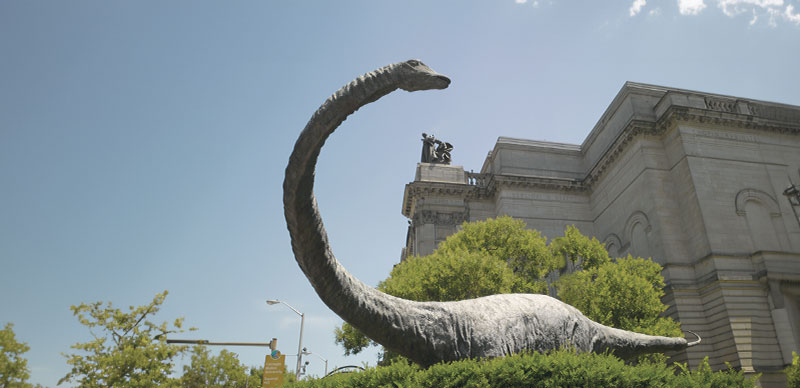
At the turn of the century the �Earth� sciences�especially paleontology and the
dinosaur collections�made the museum famous. Andrew Carnegie�s money and promotional
skills placed the �Home of the Dinosaurs� on the world stage by distributing to capital
cities astonishing replicas of the largest fossil dinosaur skeleton ever seen.
Paleontology remains a central focus of the museum, and has great public appeal.
But a century later the moving targets of scientific research include a great emphasis
on �Life� sciences, which include studies of living mammals, birds, plants, insects,
and amphibians and reptiles. Countries all over the world have begun to face the global
concerns about preserving the natural environment. And where else but in specimen
collections of plants and animals can society turn for valid evidence of the complex
web of life, for inventories of life forms past and present, and the biological databases
upon which land preservation decisions are made now for the good of the future?
Who could have foreseen that collections of birds� eggshells by 19th-century Victorian
naturalists would prove that 20th- century pesticides have weakened modern eggshells,
thus preventing young birds from hatching, leading to the disappearance of bird species?
There is a renewed urgency today in the �Life� sciences upon �general field collecting,�
or sampling everything that lives in a threatened habitat�all the plants and animals.
A museum�s stewardship of the natural world is built upon this global knowledge of
biodiversity, and Carnegie Museum of Natural History has been a leader in this fieldwork.
But if anything characterizes museum science in our time it is its interdisciplinary
nature, and the subtle ways in which questions about natural history eventually percolate
through social, legal and political arenas. One example that surfaced in 1996 is
seen in the work of anthropologist James Richardson. Although Anthropology is one
of three divisions of research at the museum, equivalent to Earth and Life Sciences
as an administrative unit, anthropology frequently requires knowledge of other disciplines.
By asking questions about the shellfish found in the ancient kitchen refuse piles
of Peruvian coastal villages in South America, Richardson soon found himself a partisan
in the debate over the origins of El Niño, the flood and drought catastrophe which
overtakes the people of the Andes every seven to 10 years. Thus archaeological digs
into 5,000- to 10,000-year-old coastal villages led to thinking about geologic change,
marine biology and finally to climatology�in the past and in the present.
El Niño, named by fishermen after the Christ child because it arrives on the west
coast of South America during the Christmas season, is the climatic phenomenon that
brings massive flooding to northern Peru and southern Ecuador, drought to northern
Peru and Bolivia, and is instrumental in disrupting the world�s weather patterns.
Analyzing the shellfish and fish remains from coastal Peruvian archaeological sites
dating from 10,000 to 4,000 years ago, researchers discovered that a dramatic shift
in the species of the marine fauna occurred around 5,000 years ago. This change from
warm water to cold water ocean organisms reflected a change in the ocean current
patterns along the northern coast of Peru.
In 1996, Richardson, research associate Daniel Sandweiss and an interdisciplinary
team of faunal experts, geologists and paleontologists published an article in Science
about El Niño. They explained that the evidence strongly suggests that the ocean current
circulation pattern before 5,000 years ago was different than it is today.
Before 5,000 years ago the northern coast of Peru received greater rainfall, resulting
in more lush conditions compared to the stark desert of that area today. This team
states that the change in the ocean currents from warm to cold signaled the origin
of the El Niño weather catastrophe about 5,000 years ago.
It has been proposed that the factor bringing about the change was the rising of
the Pacific ocean levels by 120 meters. This was because water poured into the world�s
ocean�s basins from the rapidly retreating late Pleistocene ice sheets. By 5,000
years ago, modern sea levels were attained and the wide expanse of the world�s exposed
continental shelves were submerged by rising seas, resulting in the reorganization
of the Pacific ocean current circulation system, bringing on El Niño. Although this
hypothesis is controversial, the Peruvian archaeological record of this climate change
is now being supported by evidence from Australia.
If the El Niño phenomenon began 5,000 years ago, it is unlikely to disappear soon,
and South Americans must adapt to it. Such are the indirect ways in which archaeology
leads to predictions about the modern climate.
Life Science�Biodiversity Studies
Life Science at the museum gives insight
into many local environmental issues. About 50 miles east of Pittsburgh is Powdermill
Nature Reserve, the museum�s 2,000-acre research station in the Laurel Highlands near
Ligonier. At Powdermill, a �typical� Appalachian forest ecosystem, the data about
animals and plants accumulated since the 1950s provide an essential baseline about
species that can be used to monitor the resilience of the entire ecosystem. How does
the invasion of a pest species�the gypsy moth, for example�and the human response
to it affect the delicate balance of the forest ecology? Should the forest be sprayed
to control gypsy moths or not? And with what chemicals?
University scientists in Pennsylvania and
West Virginia wrestle with the problem, and at Allegheny National Forest and other
regional sites the research on insect species monitors the residual effects of the
sprays�the killing of innocent bystander species, so to speak, and effects on the
long term �health� of the environment. Carnegie entomologist Robert Davidson has
been doing fieldwork and documentation�trapping, preparing, labelling, identifying
and reporting�on such species as beetles, caterpillars and silk moths. The jury is
still out on the long-term effects of chemical spraying on the forest environment.
Joseph Merritt, a mammalogist at Powdermill, calls small mammals the �key industry�
of a forest ecosystem. These animals feed upon plants and in turn are the food supply
for many predators that require them for survival. What should be the role of an
abundant population of small mammal species in planning for the long-term health of
Pennsylvania forests? Should humans not remove dead trees and snags from the forests,
if these sites provide essential overwintering nest sites for many mammals and birds?
Merritt�s ongoing small mammal survey employs 250 live-traps to monitor the populations
of 13 species of small mammals typical of the forest system, from shrews, moles and
mice to gray and flying squirrels. Radio telemetry techniques monitor the behavior
of solitary shrews in the winter, for example, demonstrating that these busy creatures
have thermal systems and food cache strategies that allow them to stay highly active
in the winter, unlike the communal flying squirrels, who �huddle� in group nests
to conserve precious body heat. Where else but at Powdermill would scientists demonstrate
over a 17-year period that shrews and mice live only about 15 months in the wild,
but that some chipmunks live up to eight years?
Powdermill is famous among bird-banders as the largest and longest-standing year-round
bird-banding program in North America. Since 1961 the bird-banding program begun
by Robert Leberman has monitored the timing of bird migration and the body mass dynamics
of different species. Ornithologists from academic institutions around the world use
its database of nearly a half-million records.
In 1996 Robert Mulvihill began assessing the possible effects of acid pollution
of streams on the breeding densities and nesting success of what may be a �bio-indicator�
species�the Louisiana Waterthrush. This species reveals the effects of various kinds
of human disturbance to the environment of forested headwaters in the mid-Atlantic
region. Another project at Powdermill, the long-term effects of acid drainage from
the abandoned Freedline mine, promises more information on the pollution of Appalachian
streams, one of the region�s most difficult environmental problems.
Regional research can encompass the entire state, as with Chen Young and David
Koenig�s Survey of the Crane Flies of Pennsylvania, a three-year project in collaboration
with the Academy of Natural Sciences in Philadelphia and the Pennsylvania Wild Resources
Conservation Fund. The end result should be a comprehensive database of crane flies,
which is a bioindicator insect for the health of certain ecosystems.
Regional research into mammals progressed in 1996 as Carnegie mammalogists Duane
Schlitter and Suzanne McLaren worked with a museum research associate on the first
draft of the Mammals of West Virginia, the culmination of seven years of fieldwork.
The West Virginia mammal research effort incorporates data from other museums, but
the Carnegie collection comprises about one third of the mammal holdings from that
state. These studies underscore the long gestation period of museum science as collections
develop and are analyzed by many people.
Regional studies are regularly paralleled by international projects. Schlitter,
for example, continued work with colleagues on the encyclopedic Rodents of Africa,
a work sorely needed by anyone attempting to work with African rodents, which are
key agents in the spread of infectious diseases in Africa.
Sometimes international research develops from sudden events. In 1996 Carnegie
scientist Ellen Censky, an expert on lizards of the eastern Caribbean, discovered
a ready-made opportunity to document the rapid changes in animals as they adapt to
their environment or face extinction. Censky observed that Hurricane Luis in 1995
changed the color of two different Caribbean islands. On these islands, each with
a barren, blackened limestone surface, several species of dark, patternless lizards
evolved�presumably because their color hid them from predators. But the hurricane
scoured the islands, removing the dark surface deposits from the rocks and leaving
the islands light in color. The dark lizards suddenly stood out, easy victims to
predators.
There are few scientifically documented cases of natural selection in action, but
this was an opportunity to watch a lizard population evolve in a few generations
from dark to light, in order to survive. Birds and other predators will cull the darkest
lizards from the population because they are easy to detect, and the lighter-colored
lizards will escape, giving rise to a future population light in color. In addition,
as the rocks again darken through the years, the population will return to a darker
color in order to survive. Censky was funded by the National Geographic Society to
monitor the populations.
Isolated populations of island flora and fauna have fascinated scientists since
the days of Darwin. Island populations of birds have been a long-term interest of
Kenneth Parkes, who published a study of bird species of the Philippine islands in
1991. One of his many current interests is birds of the West Indies, and in distinguishing
among the different species of brilliantly colored Stripe-headed Tanagers. This research,
including recordings of bird voices, has been done with an international team, which
will publish its results in 1997.
Isolated populations for study occur in many habitats. The biodiversity studies
in the Amazon basin have received much publicity, but other regions of the neo-tropics
also contain them, such as the creatures in the middle and high elevations of the
Andes, or the mountaintops of Central America. These have been comparatively overlooked.
Tim McCarthy has focused his collecting on diverse species of mammals that live in
the �cloud forests� of high elevations of Ecuador, Guatemala and Honduras. The old
theory that the general distribution of animals in the lower regions is duplicated
in the �island� habitats of the high mountain species is being tested. The conclusions
indicate that the genetic isolation of these animals in high elevations makes a difference,
and the evolution of such animals remote from their lowland relatives must be understood
when drawing a larger picture of mammal evolution.
Entire research collections also come to the museum by purchase or bequest. In
the Life sciences entomologist John Rawlins is in the process of acquiring for the
museum the second largest scientifically documented collection of fleas in the world�
a bequest of the late museum research associate Robert Traub of Maryland. The largest
collection is in the British Museum in London. There is no escaping the inherent
humor of a flea collection: Do you keep the world�s largest collection of fleas in
a matchbox? Can we have our own flea circus? But jokes aside, what about the biological
issues? Fleas were the vectors, the transmitting agents for the bubonic plague�the
European �Black Death� that killed millions in the 14th century. These tiny parasites
sometimes carry disease from one host bird or mammal to another. But which scientifically
identified species of flea carries the pathogens from the blood or saliva of one
host animal or bird into the bloodstream of another? Questions like this will be
answered by using the best and most scientifically documented collection of fleas.
Rawlins recently brought one part of this immense flea collection to Pittsburgh in
a truck, and there is more to come.
Locally, Carnegie botanists have been working with the flora associated with insect
trapping locations in Pennsylvania �barrens� (dry, rocky sites with special vegetation),
and at the Allegheny and the Monongahela National Forests. They have documented a
number of rare species including a lily newly discovered in Pennsylvania in 1995.
Botanists Frederick Utech and Sue Thompson are also involved in the great Flora
of North America project�a multi- volume publication that documents for the first
time some 20,000 flowering plants found north of Mexico. Carnegie Museum is part
of this multi-national and multi-institutional group undertaking one of the largest
biodiversity studies in the world.
Internationally, Utech continued field research with Japanese colleagues on different
species of lilies and beech trees common in eastern North America and Japan. Thompson
has been documenting the flora of the Caribbean in connection with museum research
on insects, and in 1996 collected plants on Puerto Rico in a variety of habitats,
including tropical rainforest, serpentine forest, dry forest and mangrove sites.
She is coordinating one of the volumes for Flora of the Greater Antilles, another
multi-national biodiversity project with the goal of producing a comprehensive treatment
of all plant groups on those islands.
Brad Livezey, an expert on birds that do not fly, recently published a chapter
in a scientific book on the evolutionary history of �avian flightlessness.� Here
is a subject apparently doomed forever to remain behind the scenes�as dead as the
Dodo in terms of immediate public concern. The museum exhibits a fascinating model
of the Dodo, which was last seen alive in the late 17th century, on the island of
Mauritius in the Indian Ocean. The Dodo became extinct because of human influence
on the island.
But a museum docent or curator can discuss the topic with modern examples such
as penguins and ostriches and swans and chickens and certain kinds of ducks. Why
do such birds that we still see today not fly, or fly very little? Flightless birds
remain prone to extinction today, and Livezey�s analysis of the evolutionary reasons
for flightlessness sheds light on the modern situation. Once the subject is explained,the
public begins to understand the multitudinous world of birds that no longer exists,
and the reasons for the surviving species of such birds that we do see.
An ornithologist, Livezey is a Life scientist, but his research also depends upon
the world of Earth science�the record of past life from fossil remains.
Earth Science�the Fossil Record
Carnegie Museum of Natural History is famous
for paleontology�the science of studying the life of past geologic periods from fossil
remains. The dinosaur fossils from about 220 million to 65 million years ago are always
popular, but lately museum paleontology has also focused on the more recent evolution
of early mammals, some 55 million years ago.
Mary Dawson�s research into fossil evidence of small mammals across the northern
hemisphere since about 55 million years ago is a good example, and helps establish
the evolutionary changes of the Earth. The fossil remains of squirrels, mice, beavers,
rats and their relatives are good indicators of these animals� ancient habitats and
environments. The rapid adaptive changes of such animals, their worldwide abundance,
and their mobility in diverse habitats, makes them important indicators of Earth
history. Dawson�s work verifies the existence of ancient land bridges between Asia
and North America, and between North America and western Europe.
Chris Beard, whose discovery of a �missing link� fossil monkey in China won recognition
as one of the most important scientific discoveries in 1996, has also been working
on early mammal evolution in North America. This year he excavated a �Red Hot locality�
in east-central Mississippi. The fossil teeth and bones of about 25 species of mammals
found here make it the most diverse fossil assemblage of early mammals in the eastern
half of North America. At the site the remains of sharks, skates and rays, bony fishes,
snakes, lizards, crocodiles, birds and mammals are intermingled and must be sifted
through�perhaps a thousand sharks and bony fish specimens are examined for each mammal
discovered.
Hunting fossil bones in the field is backbreaking yet painstaking work. After digging
by hand through eight feet of earth on a Mississippi stream bank (the �overburden�),
the fieldworker at this site uncovers a fossil-rich sediment which must be washed
and passed through a very fine mesh screen, and this strained concentrate of fossil
material is then returned to the museum where it is examined under a microscope in
the preparation lab.
The bones of these small mammals from Mississippi were apparently concentrated
by the weak currents of ancient tidal flows, which were not strong enough to carry
heavy bones and teeth very far.
Some of these early Mississippi mammals were squirrel-like or chipmunk-like in
appearance, and others resembled shrews or hedgehogs. The early shrews and hedgehogs
apparently foraged for insects and prey on the forest floor, while in the treetops
different kinds of small primates scampered. Two different kinds of opossums ranged
on both the ground and in the trees, and an otter-like animal spent much of its time
swimming in swamps and channels, foraging for small fish and mollusks. This was also
the era of the �dawn horse��the primitive ancestor of the modern horse, and of small
hippo-like animals called pantodonts. Early carnivores, primitive relatives of dogs
and cats, hunted the small rodents and other vertebrates.
Beard draws some conclusions about the biotic zone which stretched across part
of North America: �Overall, our research shows that the mammals that inhabited the
Gulf Coastal region of the southeastern United States were not vastly different from
those that inhabited the Rocky Mountain region at the same time. Although the Red
Hot locality only samples one brief episode during millions of years that comprise
the early part of the Age of Mammals, it is reassuring as a paleontologist to see
that the fantastic fossil record we have uncovered in the Rocky Mountains for more
than a century may not be such a biased picture of North American mammals after all.�
Alan Tabrum is also collecting the fossil evidence of extinct mammal life from
some 40 million years ago, collected in areas such as southwestern Montana and Utah.
In this period important animal groups, such as true rhinoceroses, first immigrated
to North America.
The adaptation of some mammals from land to life in the sea is the subject of Zhexi
Luo, an expert on the origin and early evolution of whales. In the last century creationists
argued that Darwinians could not demonstrate the missing links between early life
and human beings, but modern research continues to establish the links between sea
and land creatures. In Luo�s research, the evolution of cow and pig-like animals
into whales and dolphins�our modern marine mammals�is being demonstrated. His study
of the skulls of fossil whale species demonstrates the adaptive process by which the
organs for hearing, for example, changed so that mammals could hear sounds underwater.
The oldest fossil material collected recently by Carnegie scientists dates from
about 325 million years ago, when much of North America was covered by a shallow
sea. This sea was bounded in the central and southwestern United States by thick
reefs rich in marine life, and John Carter is studying limestone accumulations which
contain exquisitely preserved shells. The site was discovered during a road excavation
in northeastern Oklahoma.
Likewise, paleontologist Albert Kollar is documenting the life of the same ancient
seaways which covered North America, and he and assistant Ilona Weyers recently discovered
unusually large specimens in southeast Alaska. Called Gigantoproductus, these specimens
are of a rare clam-like animal from North America, and possibly a new species.
David Berman has been collecting the fossil remains of animals from 310 to 230
million years ago, when the land masses of the Earth were united in a single continuous
supercontinent, referred to as Pangaea. His excavations with colleagues in both Germany
and the United States reveal the presence of shared life forms across a narrow band
of terrestrial life around the Earth�about 20 degrees north of the paleoequator across
the southern region of Euroamerica, where a warm, humid, tropical climate once existed.
Amy Henrici, who prepares scientific specimens in the museum laboratory, is studying
the evolution and diversity of frogs through time. One of her projects is to identify
a new genus and species from Dinosaur National Monument, a fossil creature whose
modern relatives include the Mexican burrowing toad and the African clawed frog. For
the public, watching a preparator like Henrici carefully removing fossil bones with
dental tools from the hardened �matrix� which preserved them is a highlight of any
behind-the-scenes visit to the museum.
Anthropology
Collecting artifacts from past human cultures has never been simple. A century
ago when Carnegie Institute opened its doors, President William Frew wrote a personal
letter to the great scout William F. Cody, asking him if he could collect artifacts
from the Plains Indians for the new Pittsburgh museum. Buffalo Bill replied, �the
kind of articles you mention are very scarse,� and that �The uncivilized wear what
the government gives them. The buffalo and deer are gone and they live no longer
by the chase. I would not know where to buy such things as you want.�
But after a century of collecting, the museum does have an important collection
from prehistoric and historic cultures. The opening of Alcoa Hall of Native Americans
in 1998 will display Native American materials according to the latest state of scientific
knowledge. Marsha Bol, an expert on Indian cultures of the American plains, has overseen
the development of the hall.
In Pittsburgh, Carnegie scientists have proven themselves for decades as leaders
in urban archaeology and regional history. In 1996 Upper Ohio Valley archaeological
research continued with excavations at sites in Washington County, where Richard
George recorded two settlements in the ongoing effort to refine the chronological
history of the Monongahela people. Similarly, Stanley Lantz documented Proto-Iroquois
settlements in northwestern Pennsylvania and southwestern New York, and Verna Cowin
documented artifacts from Lawrence County historic cemetery sites, and Native American
burial mounds from A.D. 530 to 850.
But today field archaeology has a totally different context than it did when anyone
could write Buffalo Bill about obtaining collectible objects. On an international
level archaeology can be an exercise in international relations, as well as a cooperative
venture among scientists and ordinary people. In addition, archaeologists are now
engaged to undertake the historic preservation research that accompanies new construction
on undisturbed land and even urban sites. In the United States government regulations
frequently require that a small percentage of the site preparation costs be spent
on salvaging historic materials that would otherwise be lost. Also, historic artifacts
are no longer easily sent to other countries, since many nations now care about documenting
their own cultural history, and see scientifically validated material as important.
Research in the Caribbean by anthropologist David Watters reveals such current
themes. Several years ago Watters collaborated in an archaeological dig with Cuban
colleagues, as part of the first American-Cuban team in many years to explore a Cuban
site. In 1996 his expertise in Caribbean archaeology led to another experience.
On July 18, 1995, the Soufriere Hills volcano, which had been dormant for hundreds
of years, exploded on the small island of Montserrat in the British West Indies.
Just three weeks earlier anthropologists Watters and research associate James Peterson
from the University of Maine, Farmington, had completed an archaeological dig sponsored
by the Montserrat National Trust. They excavated pottery and other artifacts from
sites occupied by the Saladoid people for 800 years, from 500 B.C.to A.D. 300. The
site was being prepared for a new airport on the small island, which occupies only
39 square miles. Evidence of the early inhabitants was being prepared for the local
museum, and the museum is one of the features of the island for tourists.
The disastrous eruption began suddenly and without warning, venting clouds of steam
and ashes skyward, and unleashing fast moving flows of ash, rock and magma down the
east side of the mountain into the sparsely inhabited Tar River valley. On the west
side of the mountain the populous capital of Plymouth received huge billowing clouds
of ash blown westward by prevailing winds. The volcanic activity continued for a
year and a half, prompting the government to evacuate people living in Plymouth and
the southern third of the island to a �safe zone� further north.
The island�s museum in Plymouth was closed, as was the storage facility with the
many artifacts excavated by the archaeologists, who had shipped to the United States
only those objects requiring further laboratory study not possible on the island.
In 1996 Watters and Peterson returned to the island to study, reinventory, and repack
the artifacts in storage containers Watters had shipped from the United States. At
one point they were enveloped in a huge ash cloud from the active volcano as they
worked, protected by dust masks and goggles. They helped their Montserratian friends
sweep piles of ash from decks, porches and roofs, and when the rains came, shovel
the stuff away. Once hardened by water, the powdery ash turns concrete-like. But
through it all the artifacts were saved, and will someday contribute to the way that
the people of Montserrat present their history to the world.
Another example of international research
is the work of Sandra Olsen in Kazakstan, central Asia. Her focus is on evidence
of the early domestication of the horse, and the central steppes of Asia are a logical
place to look for the evidence of the way nomadic peoples first tamed horses. The
museum has been collaborating with North Kazakstan University at the site of ancient
Botai, where between 3600 and 2600 B.C. on the west Siberian plain people subsisted
almost entirely on horse meat.
The early tools found suggest the making of thongs that might have been used to
control horses, and to make whips, riding crops, bridles, hobbles, lassos and pole
snares. The hunters used the bow and arrow, spears and harpoons. Anthropologists
know that saddles were invented much later. This early people and their animals adapted
to an extremely harsh climate, where there is poor soil, low rainfall, and winters
with temperatures below -30 Celsius. Other information gleaned from excavations
include cloth weaving preserved in impressions in pottery clay, and proof of using
human skulls in a ritual manner by removing all the skin, drilling holes in the top
for suspension, and covering the face with clay.
At another site in southwest France called
the Grotte des Eyzies, Olsen has been concluding work on a Paleolithic rockshelter
site (10,500 B.C.) from which material was taken to the British Museum in 1860. Evidence
of the early hunting techniques indicate that the people subsisted largely on reindeer,
brought down with harpoons and spears. Some of the earliest evidence of air-drying
or smoking meat to preserve it comes from this site. Drying meat, like beef jerky,
reduces it to one-fifth of its fresh weight and makes it easy to transport, an important
consideration for nomadic hunters.
The international sites worked by Carnegie anthropologists, like Richardson in
the coastal villages of Peru, Watters in Montserrat, and Olsen in Kazakstan, are
a sign of the collaboration called for in our times.
After Andrew Carnegie�s support a century ago, innumerable foundations, agencies
and benefactors have made Carnegie Museum of Natural History a world-renowned research
museum. But the great specimen collections must be seen also as the result of a century
of work by dedicated researchers who go �into the field� on behalf of science.
R. Jay Gangewere is the editor of Carnegie Magazine.
ÿ