Home
Museums
Back Issues
Membership
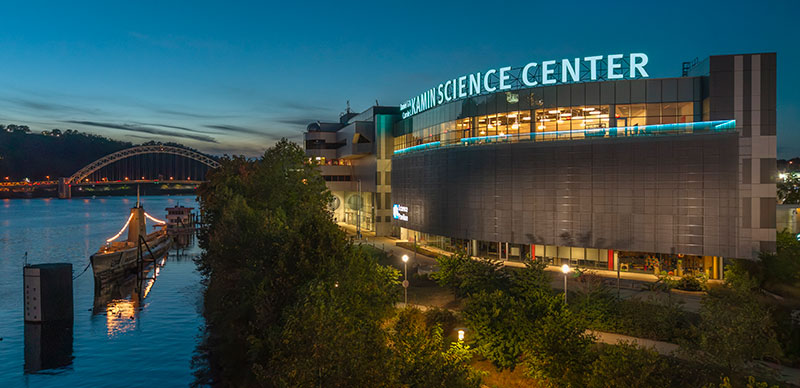
Don’t panic. The third floor of the Carnegie Science Center only APPEARS
to be underwater.
“We’ve created a thematic space where you feel like you are underwater,”
says Senior Exhibit Designer Pete Feher of the Science Center’s upgraded
SeaScape exhibit. With five aquarium tanks, faux coral covered walls, piped
in sounds of whales and waves, and a model of a sunken 16th-century Spanish
galleon, the illusion is remarkably real–and hard to wade away from. Newly
added is a mangrove tank, representing the area of a coral reef where fish
breed, 20-foot trees growing into the atrium gallery, computer kiosks for
detailed information about the tanks’ more than 400 species of animals
and plants, and underwater cameras for close-ups. An even closer look is
provided at the video microscope station where a microscope magnifies tank
creatures 180 times their actual size.
A 3-foot by 6-foot touch tank allows visitors to hold starfish, sea
urchins, and horseshoe crabs. For something surreal, poke your head in
the giant fish model called See Like a Fish and view the surroundings
as if your eyes were positioned on either side of your head!
Covered with barnacles and soaring to the 8-foot ceiling is the model
of a 16th-century sunken Spanish galleon model. “It shows how a man-made
object can become part of a coral reef,” says Feher. Inside the ship is
the ever-popular Yellow Submarine, upgraded with a buoyancy exhibit,
and a play diving suit for the kids.
Much of the exhibit’s new look is the result of the design and construction
talents of 34 Art Institute of Pittsburgh students, recruited by
institute grad Feher. These student volunteers designed the galleon and
protective coloration exhibit, spiffed up the Yellow Submarine, and sculpted
the foam and fiberglass coral. So dive in! The water temperatures
always temperate here!
ZAP! Surgery Beyond the Cutting Edge
Medical Marvels are a Personal Experience
340 / 2157
Not long ago a “surgical procedure” meant scalpels, sutures, and weeks
of recovery. Not anymore. Today the trend is toward minimally invasive
surgical technologies. Some of these technologies lasers, endoscopes,
the Gamma Knife, ultrasound, and cryosurgery are the focus of Zap! Surgery
Beyond the Cutting Edge. These technologies were chosen because
they provide a unique, exciting context for exploring basic science concepts
often presented in science centers, says Linda Ortenzo, project manager.
Featuring bright, colorful modules and easy-to-understand text panels,
Zap! Surgerys interactives explain the science behind these surgical technologies.
Video clips of real surgeries bring medicine to life, and activities allow
visitors to perform simulated surgery.
One of the most stunning components is a giant eyeball, which demonstrates
one type of retina retinopathy. Visitors shoot a laser beam into the eye,
simulating a procedure used to stop abnormal blood vessels from leaking
fluid into the retina. This is one of several activities that collectively
illustrate the properties of laser light and explain how it interacts with
body tissue, says Patty Antalis, exhibit developer.
Doctors, nurses, bioengineers, technicians, and a teacher advisory board
served as consultants on the 6,000-square-foot, $2.2 million exhibit. “We
spent a lot of time in development to make this fun and simplify the topic,
but also to make it accurate,” says Lauren Eckie, exhibit designer.
And fun is what the Zap! Jr. component is all about. Developed for children
ages five to eight, this section of Zap! Surgery features a huge reproduction
of the game Operation.® Kids can don surgical scrubs and toy stethoscopes
and use big tweezers to “operate” on Cavity Sam (yes, he does have a name).
Also pure fun is ZapCam, a four-minute thrill ride that bumps and bounces
the audience through a “ride” inside a human body.
Phase I of Zap! Surgery is completed, but Phase II (lasers, cryosurgery,
Zap! Jr., and ZapCam) runs from mid-June to August 13. The exhibit
then moves to Cleveland’s Great Lakes Science Center where it will be featured
as a part of the annual Association of Science and Technology (ASTC) conference
and will showcase Pittsburghs leadership in medical technology and healthcare.
Zap! returns to Pittsburgh as a total exhibition, opening February
2, 2001.
Home
Museums
Back Issues
Membership
Copyright (c) 2000 CARNEGIE magazine
All rights reserved.
E-mail: carnegiemag@carnegiemuseums.org