Home
Museums
Back Issues
Membership
Perform simulated laser surgery on a model eyeball.
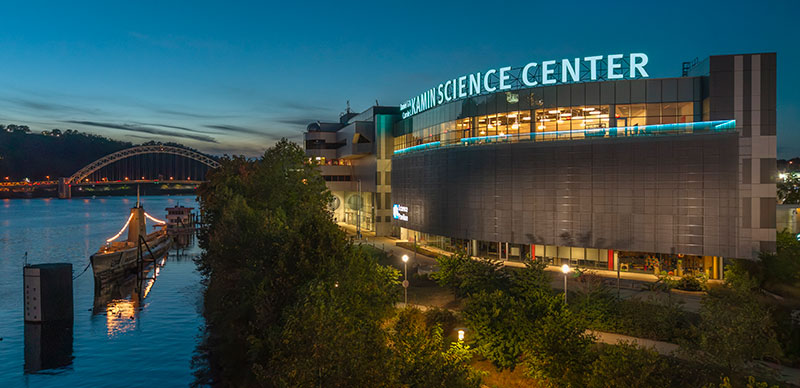
No need to ask, “Is there a doctor in the house?” at Carnegie Science Center
this spring. The new exhibit, Zap! Surgery Beyond the Cutting Edge,
makes EVERYONE a doctor!
Zap! focuses on innovative technologies in todays cutting-edge
surgical procedures. Youll discover how ultrasonic waves are used to break
up those nasty, painful little kidney stones, see gamma rays treating brain
disorders, and get a once-in-a-lifetime chance to perform simulated cryosurgery
on a 3-D animated liver.
Designed by the Carnegie Science Center staff with help from Pittsburgh-area
doctors, nurses, bioengineers, and technicians, this 6,000-square-foot
exhibit took three years to research, develop, and construct.
Zap! will be open in two “testing” phases. Phase one, April 14
through June 5, features Endoscope, Gamma Knife and Ultrasound modules.
Phase two, June 16 to August 13, has Laser and Cryosurgery modules, Zap
Jr. and the ZapCam.
Each module consists of three areas:
“Explore It.” Where you can experiment with science principles through
interactive devices.
“Be the Surgeon.” Yell “Stat!” loudly and often as you perform a variety
of simulated surgical procedures.
“Real Stories/Real Surgeries.” Where youll view video clips of actual
procedures and hear stories from real doctors, patients, and scientists.
If that isnt enough, jump on the ZapCam. This four-minute full motion
simulator thrill ride takes you inside the human body as if youve been
miniaturized–kind of an H.G. Wells/Fantastic Voyage experience.
Dodge incoming lasers, as you witness these new surgical techniques from
inside the body.
Bring the little ones ages 3 to 6 along to play doctor at Zap Jr. Basic
human anatomy and medical technology are explained while the kids put on
surgical scrubs and experiment with toy stethoscopes and X-ray images.
After the $2 million exhibit is tested, it moves to Clevelands Great Lakes
Science Center for its international grand opening (September 23 through
January 2, 2001). There, the exhibition will be reviewed by nearly 2,000
delegates from the Association of Science and Technology Centers (ASTC).
This premiere venue puts Zap! Centerstage as science centers worldwide
are scouting new exhibits to lease for their own sites. But dont fret,
Zap!
will return in its entirety to Carnegie Science Center in February 2001,
and remain through the years end.
So whether youre a teen considering a medical career, a kid who thinks
blood is “way cool,” or an adult who still loves to play “Operation,” Zap!
Surgery Beyond the Cutting Edge has something for you.
Pittsburgh Skies – The Not-So-Grand Alignment
The Buhl Planetarium & Observatory at Carnegie Science Center continues
its 60th anniversary celebration by making the universe a little
more accessible to everyone. May and June are excellent months for taking
in the sights of the night sky and learning a little more about what can
(and cant) be found in the skies above Pittsburgh. So stop by the Planetarium
to get the expert scoop on all things astronomical.
For example, youve probably heard the latest astronomical “millennial”
story that is making the rounds. This is the so-called “Grand Alignment”
of planets on May 5. The story goes something like this. On the appointed
date, all the planets will “line up” together in the sky in a way that
they have not for centuries (or millennia take your pick). The results
will be catastrophic for planet Earth.
Well, dont sell all your belongings just yet. As is often the case,
the facts have been a bit muddled. There is no alignment of the planets
on May 5. The planets can never actually align. What will happen is a gathering
of planets. The five naked-eye planets Mercury, Venus, Mars, Jupiter
and Saturn -will all be “relatively” close to each other as seen from Earth.
Close, in this case, means within about twenty-five degrees. Thats fifty
times the width of the full Moon.
And speaking of the Moon, it will be present as well. Now that would
make an awesome sight in the sky, if not for one problem. The Sun is also
part of the gathering. That means that we wont be able to see the planets
at all; they will be lost in the glare of our star!
Now, is this unseen event something to fear? Absolutely not. There will
be no gravitational effects, or any other kind, that will harm Earth. We
can be sure, because weve been through this kind of gathering lots of
times before. The last time was 1962. Thats right, just 38 years ago.
So, dont waste any time worrying about this “once in a millennium” planet
gathering, well still be here on May 6!
–John Radzilowicz, director, Buhl Planetarium & Observatory
Home
Museums
Back Issues
Membership
Copyright (c) 2000 CARNEGIE magazine
All rights reserved.
E-mail: carnegiemag@carnegiemuseums.org