Who Tells the Story at the Museum?
by R. Jay Gangewere
Can museums really resolve social questions that have existed for generations?
In our time some museums are trying very hard to re-interpret history,
to remove the racism and stereotyping imbedded in old exhibits, and to
provide “multiple perspectives” for different audiences to learn from.
The way curators and museum designers approach these issues reveals a lot
about the intellectual, moral and cultural climate of our eraùthe
“zeitgeist” or world view, as they say.
Exhibiting Dilemmas is scholarly proof that the nation’s Smithsonian
museums are fully engaged in revising the past and are often perplexed
by the cultural and curatorial debates of our era. While this anthology
of experiences by curators and exhibition designers is Smithsonian-specific,
by implication the Smithsonian’s exhibition dilemmas parallel those of
every other museum.
There is now a great national boom in museum-making — one opens every
week in America, and there are 8,000 of them that draw a billion visitors
a year, according to U.S. News and World Report (May 26, 1997). Many are
niche museums, focused on subjects of local historical interest, but others
are highly visible new museums focused on human issues that people debate
as central to their view of the world.
A good example is in Detroit, at the new Museum of African American
History, with its life casts of 50 black Detroit teens who volunteered
to become models for a display of their enslaved ancestors, as they lay
shackled in the hold of a slave ship. In Los Angeles the Japanese American
National Museum is undergoing a $45 million expansion to deliver in richer
detail the imprisonment of 120,000 Americans of Japanese ancestry during
World War II (a defining anti-Japanese ethnic experience in America), while
the Holocaust Museum in Washington has been drawing large crowds with its
dramatic illustration of ethnic murder in World War II. New museums of
Native American history are likewise determined to rewrite the mistaken
and stereotyped history of the past, and to reclaim the dignity of the
pre-European populations.
One museum belief in our era is that “objects are political.” The recent
fiasco of the Enola Gay exhibit at the Smithsonian’s Air and Space Museumùwhich
showed the bomber which dropped the atomic bomb that destroyed Hiroshimaùis
a well-known example of an exhibition dilemma. While the bomber can be
interpreted as an example of shared patriotic memories of World War II,
it also clearly is the instrument of destruction that allowed the Air Force
to annihilate a Japanese population with an atomic bomb. Fifty years after
the event, American veterans were offended by the exhibit because of the
unsympathetic interpretation of their military effort in the midst of total
war, and Japan was understandably upset about an exhibit that focused on
the destruction of the Japanese. Eventually the Enola Gay exhibit was neutered
so that it had the safe appeal of a technical explanation, without the
propagandistic interpretations that were implicit in the object.
But museums are competing for audiences with theme parks, superstores,
malls and multimedia events, and they must turn knowingly to theater and
the new technologies to attract visitors. Attracting the audience for “reality-based
leisure” is what it’s all about, says the designer of the Detroit African
American exhibit. You could also argue that successful exhibits have always
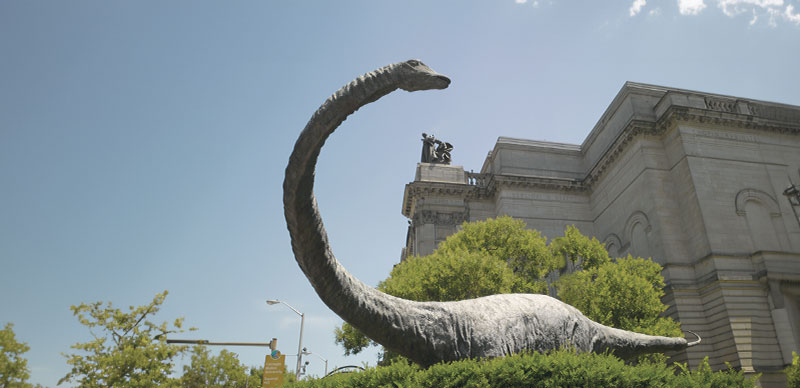
been designed that way. Certainly the theatrical taxidermy of the “Arab
Courier Attacked by Lions” (1867) at Carnegie Museum of Natural History
is a classic illustration of a fabricated event that never stops drawing
an audience.
The virtue of Exhibiting Dilemmas is that it takes the dustcovers off
many familiar displays and objects in the Smithsonian, and reminds us that
personal agendas were always embedded in museum exhibits. Take the Hope
Diamond, for example. Despite its billing as the world’s largest deep blue
diamond, it is not especially fine as a scientific specimen, argues social
historian Richard Kurin. The Hope Diamond became an icon because of the
popular legends attached to it, and it entered modern folklore as a “cursed”
objectùa precious stone that brought “bad luck” to a succession
of owners. The Hope Diamond, like some celebrities, is famous for being
famous, rather than for being a remarkable specimen. Kurin would like to
take it out of the scientific gem collection and put it in the Cooper Hewitt
Museum for Design as an example of jewelry, where its folklore could be
the major point.
Or take the ultimate in winged displays, the world’ first airplane,
the 1903 Wright Flyer that hangs in the Air and Space Museum. The third
of many Wright Brothers attempts at flying machines, it not only flew but
was the only one not destroyed, although parts were stolen or replaced.
The 1903 Flyer suffered from counter claims by a rival group, headed by
Smithsonian Secretary Samuel Langley himself, touting the Langley Aerodrome
machine as being equally “capable of flight” in 1903. In 1925 the surviving
brother, Orville Wright, crowned his frustrations with the Smithsonian’s
refusal to say his plane was the first one capable of flying by loaning
the machine to the Science Museum of London. Then in his will following
his death in 1948 he asked for return of the craft to the Smithsonian.
The museum declared it to be the first airplane, and ended a feud that
lasted for decades.
In addition, the Smithsonian led the way in declaring as cultural attifacts
the props of televisionùsuch as Archie Bunker’s chair, Mr. Rogers’
sweater, and the entire set from the TV show M*A*S*H. Collected and exhibited
by the Smithsonian as national treasures, this “television trivia” triggered
a hot debate. Weren’t these symbols of modern America as important as “Old
Glory,” or Washington’s sword, or the gowns of the first ladies, asked
the Smithsonian’s defenders of popular culture.
The victors get to write the history, is the familiar saying. Exhibiting
Dilemmas argues that the stories that museums tell are often political
tales, written anonymously by the Spirit of the Age.
R. Jay Gangewere is editor of Carnegie Magazine.