by Chris Potter
“Nowadays if you’re a crook you can write books, go on TV,
give interviewsyou’re a big celebrity and nobody even looks down on you.”
(1)
Andy Warhol
“In the original photograph I was working from, Pol Pot’s face looked
smooth and calm. …I wondered how he could look so pleasant yet treat
people so cruelly.”
Former Khmer Rouge prisoner Vann Nath (2)
Almost
a century before O.J. Simpson of Brentwood, California, there was Harry
K. Thaw of Pittsburgh. Born to a wealthy family in 1871, Thaw was an idle
spendthrift best known for his bizarre sexual appetite and his marriage
to Evelyn Nesbit, a beautiful chorus girl who had once been the lover of
architect Stanford White. That last fact came to obsess Thaw, and on June
25, 1906, during a musical revue at Madison Square Garden which White
himself had designedThaw shot the architect dead in front of hundreds
of witnesses. “He ruined my wife,” he later explained to police.
The story had everythinga beautiful woman, fame, the titillating sex
lives of the jaded and wealthyand people all over the country found themselves
warming to Thaw after it became public that White himself was something
of a cad. The subsequent trial was a sensation attended by thousands of
fascinated onlookers. “One evening his adoring crowd offered to rush the
jail to rescue him,” reports author Michael Mooney, “but Harry appeared
on the second-floor balcony and spoke to them, calming their fears for
his safety.” When Thaw returned to Pittsburgh as a free man in 1915, he
was met by a crowd of 1,000 who conducted a triumphal parade to his family
home.
Thaw died in 1947, but he took at least one secret to the grave with
him, the only real mystery surrounding the murder he committed: How had
so many law-abiding people become so fanatically devoted to a man writer
Cleveland Amory described as a “sadistic pervert,” a man whose only distinguishing
act was to murder one of the country’s greatest architects? It took more
than 60 years to find an answer, and the solution only came when yet another
criminal scandal linked yet another prominent architect with yet another
famous Pittsburgh sonAndy Warhol. Warhol’s solutionalong with corroborating
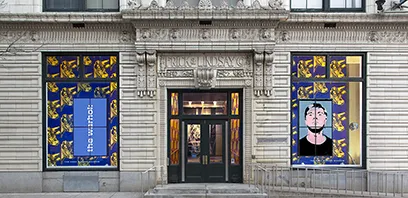
evidence from seven other artistswill be on display at The Andy Warhol
Museum in the exhibit In Your Face.
Eminent architect Philip Johnson, who had designed the New York State
pavilion for the 1964 World’s Fair, commissioned Warhol to provide a mural
for the structure’s outer wall. Warhol had unveiled his trademark images
of trademark brand names just two years before, and no doubt would have
made everyone happy if he had just stuck to soup can labels.
Instead he submitted “13 Most Wanted,” a 20 foot-square work featuring
13 mug shots from the FBI’s “Most Wanted” lists. Fair organizers were mortified:
among Warhol’s subjects were a significant number of Italian Americans
who’d been accused of ties to organized crimesure to anger visitors of
Italian descent. And wasn’t Warhol celebrating notorious criminals? Were
these the emissaries America wanted to represent it at the World’s Fair?
The mural was censored, painted over in silver before the fair even
began. Warhol suggested replacing the mural with a portrait of the Fair
official who’d banned the work, Robert Moses, but that idea was rejected
as well. So Warhol began silk-screening the images and exhibiting them
as individual works, and neither the mug shots nor the issues they raise
have been easy to conceal.
The Curator of Contemporary Art at the Museum of
Modern Art (MOMA), one in a series by Deborah Cass. America’s
Most Wanted, No.1, Robert S., 1998, synthetic
polymer paint and silkscreen on canvas. For the past eight
years, Cass has modeled her work after Warhol’s. Perhaps this
curator is “most wanted” by artists who want to see their work in MOMA.
World’s Fair officials may have worried about the image of America Warhol
was projecting, but Americans have always been fascinated by criminals.
Brutal, calculating killers like Billy the Kid and Al Capone are legendary
today, almost folk heroes. The very phrase “Most Wanted” inadvertently
reflects this paradox: “wanted” criminals are shunned by a society which
at the same time finds something romantic and desirable about the outlaw
lifestyle. As Warhol observed, “More than anything people just want stars”and
the brightness with which they shine, along with the flash from the paparazzi’s
cameras, can blind us to everything else.
“At one point we had a few of the images from ‘Most Wanted’ hanging
in our portrait gallery,” reflects Tom Sokolowski, The Andy Warhol Museum’s
director and the curator of the show. “They were on the same wall as all
those celebrities and art dealers, but they didn’t look out of place at
all.” It’s hard to say which groupthe assassins or the art dealersshould
be more disconcerted by its likeness to the other. (In the exhibit, the
question is playfully taken up by Deborah Kass, whose reworking of the
“Most Wanted” series replaces the mug shots with the likenesses of museum
curators and other art professionalsa gesture sure to be appreciated by
disgruntled artists everywhere.)
In fact, many of Warhol’s later paintings of rock stars and society
dames would have the same flattened-out quality, the same absence of feeling
exhibited in the “Most Wanted” series. Neither the mug shots nor Warhol’s
celebrity portraits make any pretense at revealing the subject’s soul,
or indeed anything other than the most superficial characteristics. Warhol’s
work and life reflected a basic truth of celebrity: The more public an
individual becomes, the more that person is obscured by the image created
around him or her. Warhol’s portraits were as superficial as our knowledge
of the superstars depicted in them.
And perhaps what’s disturbing about most of those pictured in “Most
Wanted” is not how vicious or demonic their subjects look, but how ordinary.
The subjects gaze at the camera as blankly as if they were posing for a
driver’s license photo, while one looks in vain for some stigma of their
crimesif only to mark them as different from ourselves.
This curious emptiness becomes more obvious looking at the photographs
exhibited by artist Arne Svenson. Through a series of lucky accidents,
Svenson literally unearthed an entire archive of mug shots from a small
town on the American frontierimages preserved on antiquated glass negatives.
Though the subjects are accused of crimes ranging from “petit larceny”
to rape and murder, their faces mostly share a lack of intensity. Comfortably
removed by time and distance from the menace they once posed, it’s easy
to reflect on the absence of malice in their portraits, though as Sokolowski
says, “You’d think the most demonic people would have the most intense
faces.”
Artist Nancy Burson, who specializes in using computers to distort or
combine photographic images, has half seriously experimented with that
notion. Ostensibly to create a portrait of pure malevolence, she used a
computer to combine the facial features of some of the world’s most hated
dictators. The results, ironically, were vague, uncertain composites that
seem portraits not of ruthlessness but of indecision. In this exhibitas
on the cover of this issueBurson is represented by computer-morphed images
combining the facial characteristics of men and women. The result: instead
of graphically demonstrating the differences between the sexes, she shows
how easily those differences may be blurred, how little the geography of
a face can tell us even about the physiology of the body it belongs to.
Sokolowski allows that the exhibition’s title is itself somewhat two-faced.
“On the one hand, it communicates the notion that this is aggressive, in-your-face
art that’s politically engaged,” he says. But as is so often true wherever
Warhol is concernedthere is an underlying, undermining irony at work.
“Much of what we think we’re seeing in these photographs is not in your
face. It’s in the way society sees you.”
“It’s very important to look at images and see where the real diverges
from the artificial. We say a picture is worth a thousand words, but so
much of a pictureand the way it is framedis contrived. Not long ago if
you saw someone strung out on heroin, you thought they were just loathsome
junkies. Now we have Kate Moss and heroin chic.” It’s not that criminals
have a “certain look” about them, in other words; it’s that in some situations,
having a certain look can be a crime.
At the least, such beliefs lead us to assume the beautiful people Warhol
consorted with were better than they really are. And at worst, such assumptions
underlie racism and even genocide. The exhibit reminds us of how high the
stakes can get with The Killing Fields, a collection of photographs recovered
from the Tuol Sleng Prison in Phnom Penh, where some 14,000 Cambodians
were executed by the Khmer Rouge in less than four years. The photographs
were taken shortly before the unwitting subjects were to be executed; often,
they’d been blindfolded and held captive in subhuman conditions until moments
before. Yet most of these subjects stare blankly at the camera, either
unaware of or resigned to their imminent fate. If words cannot describe
what dictator Pol Pot visited upon his people, if silence is the only expression
of that horror, then these are the mute faces speaking that silence.
“The image is not what you’re seeing,” muses Sokolowski. “It’s the frame
around it, and what is written there.”
In the end, the real subject of all these portraits is ourselves. The
blank stare with which the notorious fugitives in “Most Wanted” look out
at the world mirrored the empty gaze with which Warhol viewed the images
he was creating at roughly the same time in his “Car Crash” series and
his silk-screens of an empty electric chair. What makes those unsettling
images of death so dismaying is Warhol’s cool detachment from them, the
terrible silence pervading the death chamber, the voyeuristic appeal that
lures us to look at the gruesome wreckage of “Car Crash.” And that voyeurism
helps explain our fascination with fugitives, or even a madman like the
murderous Harry Thaw. In the end, his jadedness is not that much different
from the culture that can’t tear itself away from him or any of the other
notorious criminals who came after. If we can barely discern a difference
between the facial expressions of marauders and their victims, perhaps
it is because we see some of ourselves in each.
Chris Potter is the managing editor of Pittsburgh City Paper.
Sources
1. Andy Warhol, The Philosophy of Andy Warhol. Harvest/HBJ Books, 1975.
2. Chris Riley and Douglas Niven, The Killing Fields. Twin Palms Publishers,
1996.
Contents
Highlights
Calendar
Back Issues
Museums
Copyright 1998 Carnegie Magazine
All rights reserved.
Email: carnegiemag@carnegiemuseums.org