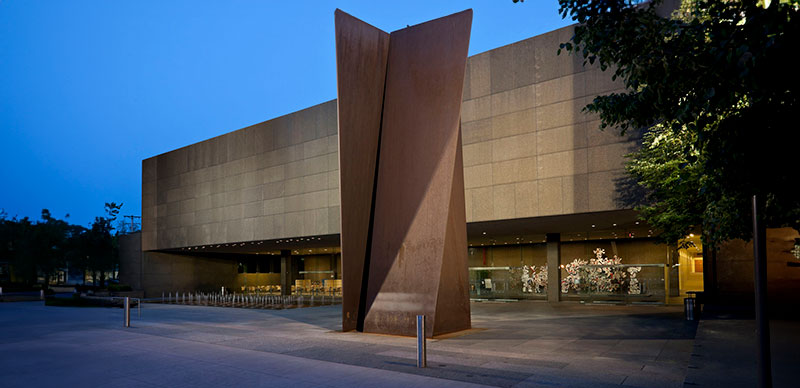
We welcome reader’s comments. Send letters to: Carnegie Magazine, 4400
Forbes Avenue, Pgh., PA. 15213, or e-mail carnegiemag@carnegiemuseums.org.
The Library Centera letter to writer Abby Mendelson
How appropriate the quote by Marlene Dietrich [“You’re a mess, honey”]
with which you began “The Library Center” in the March/April issue. Very
often those words crossed my mind whenever I was forced to pass the Bank
Center.
The Colonial Trust had been the venerable institution where my father,
Reverend David Messeroff, once proudly banked his depression salarygrateful
remuneration for his services at the small synagogue that had invited him
to Pittsburgh from Rumania.
As a former librarian at Pitt’s School of Information Sciences, I am
especially delighted with the illustrative details you use in your description
of layout and design. I am very sorry my husband Bill is not here to read
it and also see the building come to life. He helped Point Park secure
funds at a rough time in its history, and he also taught public relations
there part-time.
Thank you so much for your excellent and skillful, well-timed article!
Gert Mazefsky (Mrs. Wm.)
The Strawberry…
Is It Aggregate?
In the May/June issue, “The Strawberry: A Multiple Fruit” contains a
bit of botanical misinformation. The strawberry is not a multiple fruit
but rather an aggregate fruit with accessory tissue. A multiple fruit is
derived from multiple flowers (e.g. pineapple, mulberry), whereas an aggregate
fruit is derived from a single flower. A strawberry develops from a single
flower with numerous ovaries and accessory receptacular tissue. “Multiple
fruit” is not a traditional loose and/or fuzzy term, and I don’t know of
any authoritative work that has defined it such that it would apply to
the strawberry.
Robert Kiger
Director, Hunt Institute for Botanical Documentation
…or Multiple?
Dr. Kiger and also Carnegie botanist Dr. Fred Utech objected to calling
the strawberry a multiple fruit in the May/June Kitchen Theater column,
which I reviewed. They suggested that the more appropriate term for a strawberry
is “aggregate” fruit. Such disagreement among scientific colleagues over
what to call different kinds of fruits is not surprising given the long
history of imprecise and confusing terms applied to these structures.
Both “multiple” and “aggregate,” as well as other words, have been used
by different authors for fruits derived from separate ovaries of a single
flower since the early 1800’s (The Botanical Review, Vol. 55, pages 5372,
1989). In reviewing the Carnegie Magazine article on strawberries, I discovered
that the terminology applied to these types of fruits, which include strawberries,
is still quite confusing and at times contradictory among even basic botanical
texts!
Fortunately for botanists and others who are interested in knowing exactly
what kind of fruit they are eating, there is an authoritative publication
on this issue, entitled “A Systematic Treatment of Fruit Types” which was
written by Richard Spjut, while a researcher for the USDA Agricultural
Research Service, and published by the New York Botanical Garden (Memoirs
of the NYBG, Vol. 70, 1994). This 181-page work classifies and illustrates
different types of fruits based on examination of plant specimens and a
thorough literature review. Spjut drops the term “aggregate” altogether
and cites the strawberry as an excellent example of one type of multiple
fruit, the “glandetum.”
Scientists communicate through the use of an ever-evolving language,
which strives to achieve consistency and precision. Sometimes, as in this
case, this results in words taking on different meanings from those which
were learned many years ago. Fruit terminology was in great need of a worker
such as Spjut, who saw the confusion and has produced a major work precisely
stating the logic and reasons behind the names given to different fruit
types. In order for science to move forward, scientists must be willing
to adopt new concepts and to modify long-held ideas. We now have a comprehensive
work on fruit types and based on this work we can state that apples are
pomes, green beans are legumes, a fig is a syconium, and the strawberry
is, in fact, a multiple fruit.
Sue Thompson
Assistant Curator, Botany
Carnegie Museum of Natural History
Additions and Corrections
In the May/June issue, the 1802 stone pile mentioned in the article
about the Buildings of Western Pennsylvania book is at Greersburg Academy
in Beaver County. In addition, architectural historian Franklin Toker will
write the chapter on Allegheny County.