The New Director of
The Andy Warhol Museum talks about the artist, the museum and the future.
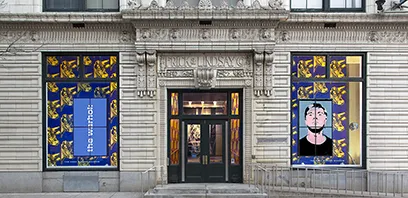
Thomas Sokolowski was named director of The Andy Warhol Museum in May, after a national
search identified him as an excellent candidate for the directorship of the two-year
old museum.A lively and energetic art historian, Sokolowski has been arts correspondent
for F/X Television since 1994, and since 1984 has been director of New York University’s
Grey Art Gallery & Study Center, where in 1989 the exhibition Success is a Job
in New York…The Early Art and Business of Andy Warhol was organized. The exhibition
was acclaimed nationally and internationally and came to Pittsburgh. A native of Chicago,
Sokolowski received his B.A. from the University of Chicago, and earned his master’s
degree and did doctoral work in art history at New York University, where he specialized
in late 17th- and early 18th-century Italian art. At the start of his administrative
career he served at the Chrysler Museum as curator of European painting and sculpture,
and then as chief curator (1983-84), and he has taught at a number of universities,
including NYU. As a board member of Visual AIDS, and Artist & Homeless Collaborative,
and as an editorial board member for Art + Text, he is active in the arts community,
and has made a number of trips to Australia and New Zealand for projects assigned
by their arts councils.
Ellsworth H. Brown, president of Carnegie Museums of Pittsburgh, noted that the
“challenge was to find the individual who could capture Warhol’s legacy of vitality
and share that with our local community as well as with our national and international
audiences,” and that Sokolowski has demonstrated success in these areas.
Here the new director shares his thoughts on Andy Warhol, the museum and its collections,
and future plans. His reflections are arranged by subject, and the questions which
triggered his varied thoughts have been deleted.
On Warhol’s Importance
There’s a climate of immediacy in Warhol’s images that contributes to his valuation
as the most important artist of the second half of the century, bar none. Not only
for America, but, I think, for the world. Much that Warhol foresaw about the future
of American popular culture has come to pass. He was eminently quotable.
Warhol’s message suggested the importance of the tawdry side of things-but as the
saying goes, you can’t blame the messenger for the message. I think Warhol uniquely
understood all of that. When you look at the visual arts today, internationally as
well as nationally, you see that the templates Warhol used are being used-not only
his techniques such as the silk screen, but his selection of subjects as well. He
used celebrities the way he did ordinary people, be they movie stars, American Jews,
or Japanese businessmen. Those modalities are now coming out in the work of young
artists, both in America and abroad. Details magazine and “Saturday Night Live” are
part of the Warhol legacy, as is this fad of club- going. …
In my opinion Warhol helped craft the way Americans perceive one another. When
we look at well- known people, we create these profiles. “Marilyn Monroe” was not
a flesh and blood person who lived, was a movie actress and then died, but a constructed
image. After a certain point the real Marilyn began to act out and live her constructed
image, which ultimately became her downfall. This lead to the notion of how we talk
about our presidents, about their “handlers,” and of how they need to play to this
mediated image of themselves.
When I spoke recently at the museum about Warhol’s portraits I related Warholian
images to images from the history of art. I showed Warhol’s Liz Taylor and juxtaposed
it with that famous bust of Nefertiti, and then with the Mona Lisa. These comparisons
help audiences discover his connections within the history of art. People aren’t used
to thinking of Warhol in this context. Many people have said to me that “we’re going
to go back and look again.”
In one way, we’re talking about the use of iconography in art. What Warhol did
in his time, in his context, was not so different, formally, from the way Leonardo
created memorable portraits in the Renaissance using tempera and oil glazes. People
have gotten the misconception that because Warhol was an excellent self-publicist
he was not really a serious artist. He was a serious artist and very aware of- increasingly
aware of-the artist’s role in the art world, especially when he made references to
an image, like that of Marilyn Monroe. He knew what Leonardo had done, and wanted
other people to be savvy enough about art to see his own references to it.
Making these connections is inevitable when you study art history. Early in my
career I concentrated on 17th- and 18th-century art. Warhol was trained at Carnegie
Tech, a serious place. He took art history courses, and had strong training in design.
While his art looks terribly au courant, that doesn’t mean he wasn’t intensely connected
to the entire history of art.
There are other connections here between the Warhol “Factory” and the workshops
maintained by great artists. Rembrandt and Rubens had hundreds of people working under
their direction. It took thousands of people to decorate the Palace at Versailles.
In this sense Warhol was hyper-traditional.
…
I would love to consider a show in a couple of years’ time that would explore the
iconography of Pittsburgh in Warhol’s art. He called his studio The Factory and covered
everything with all that silver foil and everyone thought it was so chic. But if you
went into an actual factory, what would you see? The silver backing of the insulation,
perhaps, and the metal of the ductwork. In Warhol’s early life in Pittsburgh, he saw
men who worked not in an office, but in a factory. A show about Warhol’s Pittsburgh
iconography would not have to exhibit smokestacks, but more subtle things, like assembly
lines-the notion that when you work you are part of an assembly line process whether
you are a steelworker or a printmaker.
Warhol is sometimes considered just a talented commercial illustrator rather than
a serious artist, and I’ve been asked to compare his work to that of Norman Rockwell,
who also worked in the iconographic vein, and produced stereotypes of Americana.
Rockwell, in his best moments, was a very interesting artist. I did an exhibition
on the iconography of images of sailors during the World War II years, and stressed
the idea that during that time when we had no heroes, the sailor became the hero in
American pop culture. We had a wonderful Rockwell painting from the collection of
the Brooklyn Museum of a sailor getting a tattoo on his arm-the sailor has these women’s
names on his arm and each one is successively crossed out, and the name of his current
“cutie” added. It was a picture whose meaning could be traced back to the Greek myth
about the sailor Odysseus, who in his Odyssey also represented the way we were in
some distant past.
But the problem with Rockwell isn’t so much his sentimentality, although that sometimes
gets to be a bit much, but rather that when he began doing really interesting things,
the simple machinery of getting his Saturday Evening Post covers out, and the pressure
on his illustrations to be ever more popular, led him ultimately to sell out. Rockwell’s
last images became really mawkish, but some of the early ones are really interesting.
Warhol, by contrast, kept exploring himself and evolving in his work. He started
out learning all about commercial art and for the first 10 years he worked commercially
in New York, as the exhibition Success is a Job in New York made so clear. He knew
all the things a magazine illustrator had to know, but he chose to work for periodicals
that were a bit more savvy than the Saturday Evening Post. He worked for fashion magazines
and some more serious journals, and he was able to play around a bit, artistically.
In the case of the I.Miller Shoe Company, he developed his incredible shoe advertisement,
which ran for one year, every Thursday in the exact same place on the page, in The
New York Times. One year his work won an award as the best advertising campaign of
the year. He was very aware of what went into commercial success. He was also working
for the fashion industry in post-World War II America, helping to sell products to
a rich, prosperous and positive America. After the war people not only had money but
wanted to have something new, to have their own house, their own products, and Warhol
knew all about that. Today you can’t understand the importance of Pop Art as a style
until you appreciate that historical context. …
In the 1950’s in America we got that potent image of the artist as the bohemian
who struggled to make art and challenged any naysayers. But that was not always the
case with artists. Historically many artists worked for patrons, as Warhol did.
Some people have looked at the bizarreness of some of his milieux and labeled Warhol
as a “voyeur.” We now use “voyeur” in a Machiavellian sense, or in sexual references,
meaning a dirty old man. For me Warhol was a voyeur or “onlooker” just as any artist
is. He had the artistic interest and a vicarious pleasure in seeing something outside
of himself. In his own strange way, in the middle part of his life, when Warhol was
a star par excellence, I don’t think he ever believed in his own fame.
When you look at his personal life, and his biographies, his diaries, he always
is the little boy from Pittsburgh looking into the window where he can be surrounded
by all these glamorous people who were princesses and debutantes, and trust funds
babies. He never really believed in it all, and when you read the diaries, you find
him talking and calling his friends late at night, and saying things like, “Can you
believe what she did last night?” He saw things that he thought were totally rude
and suggested ill manners and ill breeding. That was not the way he was brought up.
The use of drugs and sexual profligacy-he didn’t take part in either of those things.
I’m not saying that’s good or bad, but simply that he was always the interested observer
and not necessarily a participant.
…
In the recent show that went to Japan there was one picture which I had not seen
before, a self-portrait that he had done sometime after leaving Carnegie Tech, in
the early 50s when he went to New York. It is a self-portrait of himself with his
hands covering his face. One of the things that always struck me in the late self-portraits
was the image of Warhol’s face covered with camouflage, and the notion that Warhol
never let things out, and deliberately stayed such a clam in a certain way. But here
in the 50s we see him as a kid doing the same thing with his hands. He wasn’t yet
so clever to realize that with regular camouflage he could show his face, but in a
sense say, “I’m wearing a mask. I’m not telling you.” Early on, as a young kid, he
knew exactly his own mind set.
His sunglasses were part of his concealment, sort of, “I want to look at you but
I don’t want you to see me.” I would love to have someone do a thought-provoking essay
on those wigs he wore. Why did he wear this hideous wig-so obviously phony, so obviously
a wig that didn’t fit well? It looked like something he bought in a department store
for $19. We have a collection of them in the archive. (In fact, the actor David Bowie
who plays Warhol in the upcoming film Basquiat actually wore wigs from the archive
in his performance.) To me this seems another way in which he disguised himself.
Yet he was a magnet who drew people to him, like moths to a flame. He had the ability
as an artist, as a publicist, to make people famous. Most of the people who surrounded
him literally had their 15 minutes of fame, but did not became major figures in their
own right. I mean people like Valerie Solanis, Joe Delassandro, Ultra Violet and Baby
Jane Holzer.
The Collection and the Future
With the museum’s collection we have a unique opportunity to present retrospectives
of Warhol’s work in a way which no other museum can. Even though the quintessential
all-inclusive retrospective couldn’t be done solely through our collections because
we have gaps in certain areas, we still have the ability to give the public a far
richer view of Warhol than anyone else could.
A lot of things that the Andy Warhol Foundation for the Visual Arts has put on
loan to us, and which will eventually come to us in a few years as a gift, were things
that Warhol kept back for one reason or another, and that had perhaps sentimental
or intellectual importance for him. Or, to be perfectly honest, some works weren’t
as salable as the quintessential Pop pictures. They were oddities, but some of those
oddities tell you amazing things.
At the Warhol Museum, you can see almost everything about one man’s life, and because
of the richness, particularly of our archives, you can not only walk through the building
and look at everything that’s up on the wall and sit through some of the films that
are being shown that day, but you can also go into the archives and look through some
of the materials on the shelves. And if you make an appointment you can go into greater
depth through some of the material that’s already been catalogued. So in either one
visit or repeated visits, it’s not as if once you’ve seen it, you’ve seen it.
…
In late May of this year our curatorial team of Mark Francis and Margery King traveled
to Brazil as guests of the United States Information Agency to Rio de Janeiro and
Sao Paulo in Brazil, because there has been some interest there in doing a Warhol
exhibition. One thing that we will do this fall for the latest biennial exhibition
in Sao Paulo, is bring together a small Warhol show at their request called Public
Faces, Private Parts: Andy Warhol’s Portraits and Torsos. There is the possibility
of another retrospective chosen especially for a South American audience that would
open up in two years’ time. We’ll see what Sao Paulo brings forth.
Whenever we mount an exhibition abroad one has to be aware of the context. I would
like to see each one of these shows focus upon the context of that region of the world.
What you say about Warhol in Japan might be different than what you want to say about
Warhol in South America. The condition of exhibition spaces around the world is also
a concern. The Japanese museums are incredibly up-to-snuff in terms of climate control
and art handling and insurance. They may not have the same conditions in South America.
You don’t expect less of them, but you do have to plan carefully. Certain works are
more fragile and we might not want them to go. But that remains to be seen. We must
use the resources of our museum in a way in which we can help other places around
the world better understand Warhol.
…
We will certainly be making changes in the permanent collection on display at the
museum at least twice a year, not only to juice up the visitor’s experience with new
juxtapositions and to give the public new perspectives, but also because certain works
on paper have to be rotated because of potential damage from light levels. When someone
comes to the museum two or three times a year they will see different art from the
permanent collection in addition to the temporary exhibitions that will be going up.
Although we are a one-artist institution, our programming will transcend that.
For example, in the show that we opened in May on the Velvet Underground there were
images not by Warhol, but that connected to the Warhol ethos, and the Warhol myth,
and the Warhol history. Our museum is not just going to be a mausoleum. I am very
concerned that it not be that.
The museum has a particular appeal to youth. In May of 1996 we celebrated the museum’s
second birthday with a party. We began the evening with a traditional cocktail party,
but before it was over we had 600 people-three times the number of people we were
expecting. That was very exciting.
But, almost more important than that, was that afterwards from 9 until 2 in the
morning, we had an outdoor party, and we had 1,500 people-mostly younger people. We
had music outside and projected some of the Warhol films in the building, and kids
were just streaming through.
…
When I was being interviewed for this position I was asked what was the first thing
I would do. And I said that certainly, a high priority is to raise money. But on another
level I think an immediate job in my first year is in public relations. One needs
to make the point of why the Warhol Museum is worth having in this city. Why it is
valuable for the community? If you are going to ask people to make a donation, whether
it’s $50 or $50,000, there has to be something that they think is worthwhile. Any
institution, whether it’s the Carnegie or a hospital, or a university, or a methadone
clinic, has to be seen to be serving some part of the populace to deserve support.
The Andy Warhol Museum needs, as does any other institution, to have a group of
people who are very much committed to helping us do what we have to do. To raise funds,
and to connect with people in the local community or the national community or perhaps,
international community.
The museum passed an important milestone at its second anniversary this year. I’ve
met with Andy’s brothers, John and Paul, and found them very interesting. In fact
about 35 of Andy’s relatives attended the anniversary party, and they were quiet and
unassuming-family traits that you can see in Andy, too. While the other people at
the party had professional reasons for attending, Andy’s family-his brothers, nieces
and nephews, and his aunt-really seemed to be there to recognize the honor being heaped
upon this artist in their family. This struck me, in a way, as profound, and without
any relation to the world of art criticism and the debates that surround Warhol’s
reputation and Pop Art. It seemed to me very much another way in which Andy Warhol
belongs to Pittsburgh.
R. Jay Gangewere is the editor of Carnegie Magazine