Home
Museums
Back Issues
Membership
A First Look at Exploration Station
By Ellen S. Wilson
Kids experience the process of science by diving into a creative environment
The billiard ball caroms down the table, bouncing off rubber o-rings that
have been stretched around pegs, and drops into a hole with a satisfying
plunk.
“Youre supposed to aim for the holes?” I ask. I dont get
it yet.
“Thats up to you,” Dennis patiently explains. “They can be goals or
traps.”
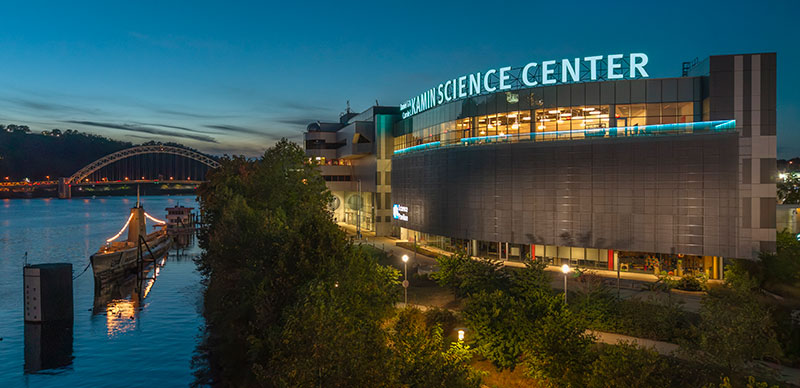
Were not in some pool hall. Were at Carnegie Science Center playing a
game called Rebound. Dennis Bateman, Exhibit Development Specialist and
Georg Taube, Senior Exhibit Designer led a team of Educators, Development
Specials, Designers, and Technical Staff in producing the exhibition. On
this brisk October morning, Dennis is showing me around the new Exploration
Station and Exploration Station, Jr., scheduled to open February 18. At
the moment, we are touring the cavernous Miller building, a warehouse where
prototypes are developed and final components assembled. About 75% of the
components for the new exhibit were designed right here, says Dennis, and
about 60% of them are being built here. But back to Rebound, which took
two months to design by Georg and his colleague, Bryan Abraham.
“I find that if you try to avoid the holes, youve
got a really good chance of hitting them”
“I find that if you try to avoid the holes, youve got a really
good chance of hitting them,” says Dennis. This is a perfect example of
the Science Centers “open-ended experience.” You can change the placement
of the o-rings, and get a different outcome every time. “And if you decide
you want to snap the kid beside you,” Dennis says, demonstrating with a
rubbery o-ring. “They dont snap. We tested for that.” Educators and a
family advisory panel were consulted throughout the planning stages of
the new Exploration Stations, but the appeal of the new exhibit boils down
to the fact that the Exhibit Development and Design Department at Carnegie
Science Center know whats fun.
Dennis and Georg love open-ended experiences, as do all the other team
members. Dennis and Georg are a kind of dynamic duo, quick-witted and creative,
playing off of each others jokes and obviously enjoying their work. They
both have a similar twinkle in their eyes and an obvious mutual respect.
Soon visitors will get to play Rebound and a host of other “explorations”
in the comfort of a newly refurbished fourth floor. The large windows,
which were always there, but have been covered over, are being opened up,
and new carpeting delineates two different Exploration Stations. The early
childhood area, Exploration Station Junior, is geared toward children ages
3 to 6, and represents a decision by the Science Center to provide more
activities for this younger age group. The original Early Learners Landing,
on the third floor, has been a popular area for young children since the
Science Center opened in 1991, but it was too small. The new area is 40%
bigger, accommodates families more comfortably, and holds as many as three
school groups at a time. It will be easier now for adults to interact with
children. Tips for parents, such as simple facts to help explain the whats
and whys, will be posted as well. The water table, the most popular item
in the old Early Learners Landing, is being expanded, with an additional
basin, new water toys, and ramps to make it more accessible. The Archimedes’
screw, which moves water up a hill, will be shortened, and Design Assistant
Mary Hoehl, who redesigned the entire water table, has added an interactive
paddle wheel so that children can more easily see how the screw works.
We saw that young children really couldnt understand that their own
actions were making water pour into the top basin,” Georg says. “We learn
a lot from observation here. Hopefully, each gallery is better than the
previous one.” Dennis has a background in film production, and Georg majored
in technical design for the theater, and has experience designing toys
and arcade games.
“It seems odd, but it ends up being a good fit,” Dennis says of their
different backgrounds. “We have access to scientific advisors, but were
not scientists,” Georg adds. “We know what it takes to get people to understand
these principles.”
As we look around the new exhibit space, we see two teen-age girls sitting
on the floor in one corner, thoughtfully enclosing themselves in a cabin
made of Timber Doodles, an invention of the Science Center design staff.
These large foam building pieces modeled after Lincoln Logs are aimed at
a much younger audience, but so what? There is something about the sight
of the girls on the floor forgetting all about looking cool that is eminently
pleasing to Dennis and Georg. The Timber Doodles will go in the Construction
area of Exploration Station Jr.
The early childhood area also includes an Agriculture section, complete
with the large tractor children love to climb on, a shallow sandbox with
some toy tractors pulling different tools, and plastic vegetables that
slip into rows of carpet “soil.” I know my own children, at age 3 or even
younger, would have spent hours earnestly planting and harvesting these
vegetables. The Ball Factory lets children explore simple mechanics and
principles of movement through the use of buckets, jets, a conveyor belt
and spiral ramps. They might even reflect on the similarities and differences
between the movement of balls, and the movement of water. Or they might
not. There is no right or wrong way to do this.
After all these activities, the Quiet Spot, with books, seating, a place
to regroup, have a snack, and figure out what comes next, will be a welcome
spot for everyone. Exploration Station Jr. will be separated from the rest
of the 4th floor activities by an observation deck, a 7-foot
high wall with bridges, platforms, a catwalk, and lots of different things
for children to look through – lenses, colored filters, fly eyes. Young
children can even peer down at their older siblings in Exploration Station.
A Chick Hatchery will be accessible to both Exploration Station and Junior,
with age-appropriate activities on each side to learn about animal needs
and habitats. Younger children can crawl through a tree and play with animal
puppets, while on the other side, older kids experiment with Build-A-Critter,
a foam animal form to which they can add wings, a trunk, a beak, or different
types of feet.
One activity that is sure to be a highlight of Exploration Station,
the area for children 7 and up, is Riverscape, a Three Rivers-shaped water
table with a fast current. Magnetically anchored dam walls, stacking topographic
plates, pumps, siphons and locks provide endless ways to manipulate the
natural movement of the water and capture its energy. This is one of many
ways in which the Science Center deliberately stresses the relevance of
science to this region. How many of these children will have their lives
affected in some way by the rivers rolling by outside?
Other areas in Exploration Station are devoted to Mechanics and Engineering,
Electricity and Magnetism, Motion, Sound, Structures, Simple Machinery,
and Animation. My own family came across one item, Plumb Crazy, in its
prototype phase a few months back and spent a good half hour on it. This
Velcro wall has an assortment of PVC pipes that you can stick on and roll
a ball through, letting it go in and out of the holes and ending up, maybe,
where you intended it to go. “You could learn about gravity,” says Georg.
“But its really about engineering and design.”
“We learned from the SciQuest exhibit that the most popular activities
were open-ended,” Dennis explains. Its the Science Center way – getting
involved with the process rather than just pushing a button and making
a light go on.
Visitors can play with the principles of animation at the Strobe Station,
which shoots a strobe light at various spinning images. One alternates
pictures of a buffalo and a cage, and if you get the strobe blinking just
right, the whirling buffalo actually ends up in the cage. Another disk
has discombobulated pieces of a face. With a few adjustments to the strobe,
the face is back together.
The Animation station consists of a blue square on a table, which appears
on a computer screen overhead. We put a plastic goldfish on the table,
press Record, move the fish, record again, and when we push Play, the fish
swims up and down across the screen. From the soundtrack selection, we
choose “Happy Tune.” We add a little green person, a scream . . .
“Basically, we provide the materials, and let the visitor explore,”
says Dennis. And what the visitor to the Animation area will discovery
is a greater understanding of how electronic images can be manipulated,
and a sense of control over what is typically a passive experience.
There is a model of the water cycle and purification process, that uses
small whiffle balls instead of actual wastewater. Sometimes the ball goes
to the farm to be fertilizer, or to the water treatment plant. If it falls
from the rain cloud, it usually goes right into the water table. But not
every time.
“Its just ,” says Georg, “ wacky fun,” says Dennis.
In the Sound area, visitors can play a harp made of laser beams
(Dennis says interrupting the beams with a comb rather than your fingers
produces the best effect) or play a pipe organ made of PVC pipes. “We use
a lot of materials in ways that the manufacturer didnt intend,” Dennis
explains, unnecessarily.
Finally, we end up at the digital drums, which allow visitors to choose
the sound the drums will make – various instruments, waterfalls and surf,
animal noises. Georg records his own voice saying “ouch,” and then plays
a symphony in ouch, with different pitches and speeds.
I could play with these drums myself for an hour, but we are distracting
the rest of the staff, and anyway, its time to go. Ill be back soon with
my family.
The new Exploration Stations are a part of the continuing mission of
the to make science more accessible, and to illuminate the mysteries of
the world, whether we normally view things through the lens of science
or not. Making goofy animated cartoons, fooling around with ball trajectories,
and controlling the current in a small river help you grasp the way the
real world works, although you may not be immediately tested on your new
knowledge.
Science is not a game, after all, but that doesnt mean you cant have
fun with it.
Home
Museums
Back Issues
Membership
Copyright (c) 2000 CARNEGIE magazine
All rights reserved.
E-mail: carnegiemag@carnegiemuseums.org