Home
Museums
Back Issues
Membership
�
Re-inventing Carnegie Science Center� �����������
By Ellen S. Wilson
�We�re not just
selecting a form, but an architect who listens.�
������������������������������ �������������������������� �����- Seddon Bennington
����������� One look
at the Architect Competition Brief for the expansion of Carnegie Science
Center and it was clear that the selection committee members wanted much more
than just a container for human activity.�
They wanted to hold on to what has worked so well despite having
outgrown its original building, and then make it bigger and better.� They wanted a new icon for a city in the
process of reinventing itself. To get those results, they had to first find
an architect who could build not just a building, but a relationship.
��This is not about
which model is the most seductive,� emphasized Seddon Bennington, director of
Carnegie Science Center, as the competition was drawing to a close.� �How will each one work for our
programs?� We want the architects to
discuss the quality of experience for their spaces, and not simply what goes
where.� We�re not just selecting a
form, but an architect who listens.�
����������� The
challenge put before the architects included the following requirements:� Consider the audience, diverse in age as
well as economic, cultural, and educational backgrounds.� Make it inspiring, participatory, vibrant,
exciting and fun, while encouraging individual concentration and focus.� Integrate indoor and outdoor
programming.� Provide an exterior
environment that is both welcoming for foot traffic and eye-catching from
afar.� Celebrate Pittsburgh as a world
leader in science, technology and education.�
Exemplify advanced green technology. And finally take into account the
high number of rainy, snowy, icy, or merely gloomy days.� This may be a lot to ask, but Bennington
thinks we deserve it.
����������� There are
many ways to find an architect, but Bennington and the Science Center board
of trustees decided that an international architectural competition would not
only fit their needs best, but would have the best results for the people of
the region.��
�We�re clear about our own program,� Bennington said.� �But the region has a program, too.� We felt we could raise the bar in terms of
expectations for what else is built on the North Shore.��
����������� Pittsburgh
is increasingly becoming an architectural showplace, and this is a good thing
� it makes the city more of a tourist destination, which brings in dollars
that improve our quality of life.� If
we see ourselves as residents of the global village, then talented young
people will find their future lies here, rather than in New York or
Paris.� And that means that big
corporations who like to hire outside talent, designers or consultants, will
find the people they are looking for closer to home.� All of those incremental successes will
banish Pittsburgh�s famous inferiority complex, hopefully forever.� This is not too much to ask of a building,
if the building is part of something bigger.
�The Science Center occupies a key piece of real estate in
terms of the future of the city�s riverfronts,� says Davitt Woodwell,
Executive Director of the Riverlife Taskforce and a member of the advisory
group helping with the selection of the architect. �There is an area from the
Point to the West End Bridge, on both sides of the Ohio, that has not gained
as much attention as some other sections, and the possibilities there are
really phenomenal for redefining how Pittsburgh thinks of itself as a waterfront
city.
����������� �The city
of Pittsburgh alone has 37 miles of riverfront.� To put that in perspective, Baltimore�s Inner Harbor, which
gets so much attention, really is only about three miles of total waterfront.� We�re not going to turn everything into another
Inner Harbor, but there are lots of opportunities now to make a
once-in-a-century decision about how we’re going to develop and use the
rivers for commerce, recreation, housing, and natural areas.� This is a chance we haven�t had since
sometime in the 1800s.�
����������� �Creating
great buildings and spaces is a complex and somewhat magical process,� says
Paul Rosenblatt, a principal at Damianos + Anthony architects and a member of
the advisory group.� Choosing an
architect for this project, an architect who will be our partner and get to
know us, has been dynamic �� a
conversation not just between the architects and Bennington, but also
involving the advisory committee, local architects, the media, and the people
of the region.
����������� �There is
an inherent conflict between our need to make a confidential decision in the
context of a disciplined competition and our determination to make the
process as public, as open, as we possibly can,� Bennington explains.
For this competition, Rosenblatt provided an initial list
of 20 architects for the selection committee to consider.�� �We intentionally sought architects that
were known internationally for their innovative approach to designing
buildings that create an impact,� Bennington said early in the process.� �We want a signature look for the
re-invented Center.� We want to go
beyond functionality to an interior and exterior that matches the dynamic
nature of our programs.��
Nine of those 20 architects came to Pittsburgh, and of the
nine, five were asked to submit concepts for the re-invention.� �Each of them could do a splendid job,�
says Bennington, �but we were trying to identify those that related to us in
a special way.�
����������� Each of
the five concepts submitted was very different from the others, another
benefit of a competition.�
Competitions, Bennington says, stretch not only the prospective
client�s thinking but the architects� as well, forcing them to go beyond
their previous work and come up with innovations that they can then draw on
in future projects.� On top of that,
competitions keep the public interested.�
This is one more opportunity for the Science Center to educate.
����������� �Contemporary
architecture is always controversial, like contemporary art,� Bennington says.� �A degree of controversy is always a
component, because it stretches the conventional.� It can lead some people to opposition, but the more we can turn
that to open interest, the more we�re doing our job.����������
����������� The
public was invited to give its opinions of the designs through the Science
Center web site, and many people accepted the invitation with gusto.� While some comments were succinct, others
went on for pages.�
�The advisory committee is reading all of the comments,�
Bennington says. �It is important to know the public reaction and
preferences, to ensure that if we differ, we understand exactly why we
differ.� Public involvement requires
us to be doubly sure of the final choice and to explain our decision.���
Early in February, the field of architects was narrowed to
three:� Daniel Libeskind, Jean Nouvel,
and Ben van Berkel of UN Studio.� They
were asked to refine their concepts to show how their designs would work with
the existing building in order to reinvent the Science Center and make it
exciting and accessible to the community as a whole.� The timetable calls for ground to be
broken in 2003, and the newly expanded Science Center to open in 2004.
More is . . . More
����������� �We�re
turning school groups away now,� Bennington says.� �The building is far too crowded for the kind of quality
experience we ought to be offering our public.�� And yet the expansion,�
which adds 160,000 square feet of exhibit space, is about more than
size.
����������� An
outdoor� Discovery Park will be a
year-round family destination that not only establishes a new green space in
the formerly industrial riverfront, but also provides a new connection to the
neighborhood.� It won�t have a fence
around it, Bennington promises.�
�Parks say very strongly, �community connection.���
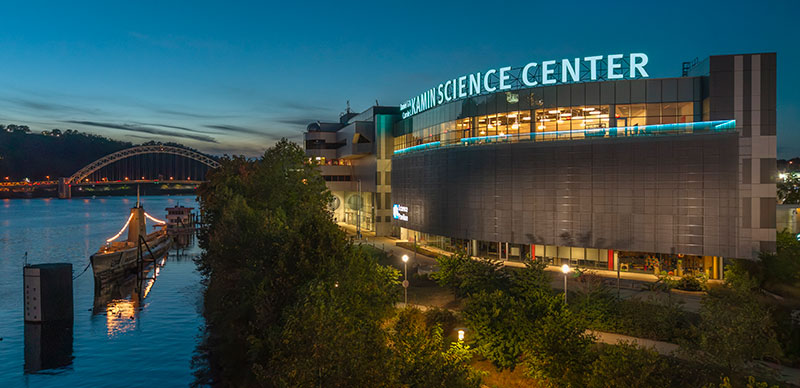
����������� A WWII
Destroyer Escort, the Stewart, will dock alongside the USS Requin, providing
not only 200 more spaces for the popular �Submarine Overnighter”� program, but a lot more ways to study such
principles as displacement, buoyancy, and hydrodynamics, as well as
metallurgy, chemistry, and history.�
The ship will enhance the Science Center�s connection to the
riverfront, and tie in naturally with the area�s history, since ships of this
type were built in the area and Allegheny County has the second highest per
capita number of WWII veterans in the country.
One new permanent exhibit, UPMC SportsWorks, will open
temporarily in the building adjacent to the Science Center in time for
football season. The dozens of activities relevant to the region�s love for
sports � such as virtual snowboarding, golf and basketball, a climbing wall,
and a unicycle on a 15-foot-high beam � illustrate balance, center of mass,
center of gravity, and other natural laws that athletes make use of .� When the expansion is completed, UPMC
SportsWorks will move into the new space.
����������� And so,
in a few years, we�ll have our new building, our children will enjoy even
better school trips, and there will be more weekend afternoons when a visit
to the Science Center is the thing to do.�
But, like all thoughtfully carried- out, creative enterprises, we�ll
have more than that.
�The Science Center process has caused many important and
caring people to make an extraordinary commitment � reaching for a very high
level of design, which has not always been the case in this region,� says
Sylvester Damianos, president of Damianos + Anthony and a member of the
advisory group.� �This to me is as
critical as selecting the right architect.�
�We here in Pittsburgh should not be inhibited by the
expectations that we will capture the attention of the world.� It is not and cannot be automatic.� However, with this incredible Pittsburgh
site, broad community support, a most thoughtful selection committee, and an
excellent pool of talent, we can make a major contribution to the world of
science and architecture � and let time and success create the broader stage
of recognition.�
Home
Museums
Back Issues
Membership
Copyright (c) 2001
CARNEGIE magazine
All rights reserved.
E-mail: carnegiemag@carnegiemuseums.org