Home
Museums
Back
Issues
Membership
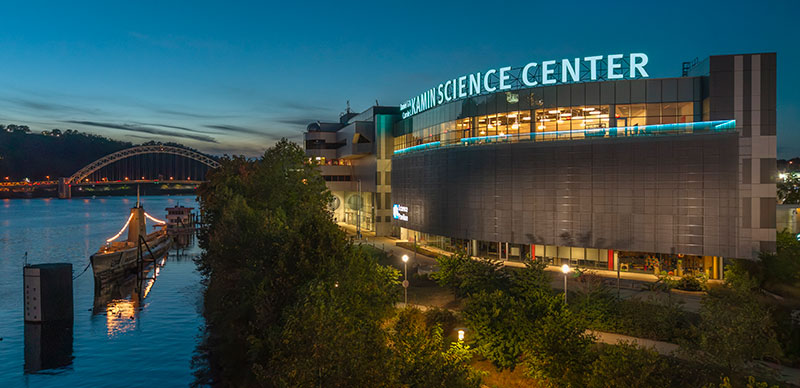
At the Carnegie Science Centers Science
Carnival exhibit, physics
isnt hard, its fun.
By M. A. Boldurian
Science Carnival opens on the second floor
on July 3. In October it moves
to the fourth floor for the holidays.
Physics surrounds
us,” says Sean Lally, Sewickley Academys Science Department chair and
a winner of the Carnegies 1998 Science Award for Excellence. “From driving
in a car, to the moon going around the earth — its unavoidable.”
While most people can define physics as
the study of matter and energy and the relationship between them, if you
probe further youll undoubtedly get a blank stare. “Physics gets a bad
rap,” says Lally. “You hear the word physics and you think, thats really
hard.”
While Science Carnival is aimed primarily
at middle-school-aged children, there are attractions for toddlers and
exhibits perfect for inquisitive adults who wonder why things happen the
way they do. After spending a day interacting with Science Carnivals exhibit
pieces, youll be able to impress co-workers with your new-found knowledge,
help your children understand a difficult science and, best of all, not
have to give the deer-caught-in-the-headlights look when physics comes
up in a conversation.
Featuring 21 highly interactive displays
in a 5,000-square-foot space, Science Carnival touches on basic physics
principles (forces, motion, optics, sound and energy transfer) as well
as engineering, machines and cognitive thinking–all with large, hands-on
colorful exhibit components. Visitors get to play with a giant Newtons
Cradle made of basketballs, spin in a gyroscope and ride a balance bike
— all in the name of science.
Exhibit Development Specialist Dennis Bateman,
who produced Science Carnival with the help of a development assistant,
three designers and six fabricators, says the exhibit will help acquaint
visitors with physics, and get them to accept the concepts.
According to Lally, a basic physics understanding
is important to everyone because it helps us understand simple things and
why they happen. It also protects us. “Youre less likely to be duped by
techno-speak or pseudoscientific talk if you understand physics,” Lally
says, referring to unreliable science websites, using pendulums for predictions,
and books which use quantum physics as psychology.
If youre thinking, “this sounds much too
complex for my child,” fear not. “Any age is an appropriate age to be introduced
to physics,” Lally says. “Different ages will get different things from
an exhibit [such as Science Carnival].” Lally adds that by middle school
all children should be getting some physics basics.
Science teachers often have one of two
approaches to teaching physics. Some adhere to a purely conceptual method
(i.e. no math), while others, such as Lally, feel teachers do a disservice
to their students if they do not include those mind-boggling math formulas.
“My students say, Why do you obscure this
with mathematics,” Lally says. “But thats
what you need to make predictions. Physics is modeling reality, and to
describe anything you use models. Math is one of the tools used to describe
things.” Lally also subscribes to the school that thinks students should
get their feet wet in physics before going on to other sciences such as
biology. “Physics deals with all there is — from the smallest particles
to the largest — the universe. Since it covers so much, it makes sense
to present it to students first.”
Dennis Bateman says that when children
have fun doing something, they are more likely to retain information. Therefore,
exhibits such as Science Carnival are great introductions into the daunting
world of science — the enjoyment children have interacting with the exhibit
pieces can later be drawn from while theyre in the classroom.
Bateman adds that because the Science Center
has a larger budget and access to a vast display space, it can produce
an exhibit unrivaled by any classroom.
“Physics works no matter what the size
of the exhibit is,” Bateman says. “We give a sense of scale…things parents
and teachers cant do.” Bateman, however, stresses the exhibit is meant
to augment the classroom and family role, not replace it.
This is some of what youll experience:
The Newtons Cradle is a great example
of the scale the Science Center can produce. Ever seen one of those little
pendulum toys with steel balls frequently found on the cluttered desks
of busy executives? Now imagine those balls are the size of basketballs.
Swing the first ball, watch it crash into the next and send the last balloon
the line flying. Fun? Yes. Mindless? Not really — if you consider its
a perfect example of the law of conservation of energy which states when
any object is given a certain momentum in a given direction, some other
body (or bodies) will receive an equal momentum in the opposite direction.
In this case, the momentum of the first ball is conserved as it hits and
travels through the other balls. This summer remember those bouncing balls
when you bowl, play pool, or, if youre a busy executive, swinging the
steel balls on your desktop “toy.”
The tightrope walk usually draws the most
oohs and aahs at a circus. Science Carnival lets you perform your own tightrope
act. Suspended six feet off the ground on a one-half inch cable, the Balance
Bike allows you to pedal safely — without a net — across the room
no matter how much you weigh. This feat is accomplished thanks to the 200-pound
counterweight, located five feet below the bike, which moves your point
of balance or center of gravity below the wire instead of above it. In
physics thats stated: “the single force equal to the entire weight of
an object and considered to be acting at a given place called the center
of gravity.” At home you can try to find the center of gravity of different
objects by balancing them — if you support it at any point other than
its center of gravity, it will keep moving. Objects, therefore, become
more stable the closer theyre balanced to their center of gravity. This
is why ice dancers lift their partners from the waist and not the shoulder
or hips.
Summer brings the serene sounds of windchimes
chiming. But why do all windchimes sound different? The Pipe of Pan
exhibit helps explain as you create your own tune by hitting the ends of
giant pan pipes with foam paddles. The different lengths of the pipes affect
the tone (a different amount of matter is being vibrated). The display
also demonstrates resonance — the process by which sound vibrations build
up — and pitch — the degree of highness or lowness on the musical scale
judged by the frequency of the soundwaves. As you play with this display,
see if you can predict what type of tone the different lengths of pipe
will produce. Next time you buy a soft drink, try your own resonance/pitch
experiment by blowing across the bottle top and notice how the sound changes
the more you drink.
As youre enjoying the next blockbuster
at the local multiplex remember youre seeing individual “photos” on the
screen, not actual motion. But because the images flick by so quickly (24
frames per second) by the time your brain catches up with your eye, the
image has changed. This is persistence of vision. At the Zoetrope
conduct your own persistence of vision experiment — twist the eight rubber
figures mounted on a wheel into different poses, spin the wheel and watch
as the eight figures appear to become a single moving character.
Lightening strikes, a few seconds later
thunder crashes. Why? Light travels faster than sound. The Sound Tube
demonstrates the sound delay as you speak into one end of a 200-foot tube
and then, a fraction of a second later, hear the words in the earpiece.
Sound is not instantaneous.
And thats just the beginning. Spin like
a toy top in the huge 3-axis gyroscope. Lift a group of people off the
ground at the Lever Lift. Become an engineer while playing with
the Catenary Arch displays large upholstered foam pieces. Keep
the wee ones busy with the Build It! exhibits giant foam blocks.
“Any age is appropriate to introduce the
basics of physics to,” says Lally. “It deals with simple things, but in
a way you never thought of before.”
Isnt it about time you understand?
–Suggestions from Sean Lally, Sewickley
Academys Science Department chair
M.A. Boldurian is a senior editor at
Mt. Lebanon Magazine, and a free-lance writer.
Tips for parents
to help children with science
Helping children understand
physics — or any science — involves more work than a fun visit to the
Science Center. Remember that summertime is a perfect time to experience
the variety of science. Here’s how to help–both in and out of the classroom.
1) Its OK to
say “Gee, I dont know,” but be ready to help your child find the answer.
If its a simple
answer you seek, try your childs textbook, the Handy Science Answer
Book series, advanced texts (college), or the Internet. Be aware,
however, some Internet sites provide misleading or wrong answers. While
some sites (such as NASA) are reliable, others are more difficult to evaluate.
Always put the impetus on your child to find the answers.
2) Make it a project,
and be excited about finding an answer. If your child wants to know
what the climate
is like on Mars, make it a team effort — with your child in control. Its
never too early to give a child intellectual responsibility, even if you
have to help as a guide.
3) Dont give
up easily on the problem. Some problems take days, months or even a
lifetime to solve. When do you stop? Thats difficult to answer, as it
depends on the question and your child. If your child wonders why they
get queasy on a roller coaster, youre in luck. If they ask you to describe
the structural nature of subatomic particles, you may have to punt. Always
give it a good try.
4) Help your child
keep good notesinside and outside the classroom. Taking a notebook
to a museum can be a great family activity. When your child sees something
interesting, puzzling or curious, have them write it down. Draw diagrams,
list questions, write down names of scientific principles and list ideas
for family projects. For school, each subject should have a separate notebook,
and each entry should be dated, titled, organized and legible. Tell your
child its okay to keep a “geeky” notebook with multiple colors and diagrams.
Not only will this help them study more effectively, but friends will seek
them for help when theyve been absent.
5) Take advantage
of local opportunities. In the Tri-state area, we are fortunate to
have many avenues to pursue intellectual curiosity. Dont wait for school
field trips to attend public university lectures, the Carnegie Museums,
classes, workshops, local nature centers or stargazing nights. This can
be as simple as a walk in Frick Park or as organized as a day trip on the
Pittsburgh Voyager. And have your child explain things to you–explaining
something to someone else is truly the best way to learn. Just ask a teacher!
6) Set up a home
study area thats free from distraction. Be away from TV, stereos and
the Internet (depending on its use). Each evening should include a quiet
study time. This will help your child structure their school and free time.
Be a part of this — take time-out to work on a quiet activity beside them.
If space permits, help your child build a small science lab for simple
at-home experiments.
Home
Museums
Back
Issues
Membership
Copyright (c) 1999 CARNEGIE magazine
All rights reserved.
E-mail: carnegiemag@carnegiemuseums.org