Experience Flight, Natural Forces and Waves at a New Science Center Exhibit
By Mark Petruzzini
According to the National Earthquake Hazards Reduction Program, there is only a
moderate possibility of an earthquake in Pittsburgh. But at the newest addition to
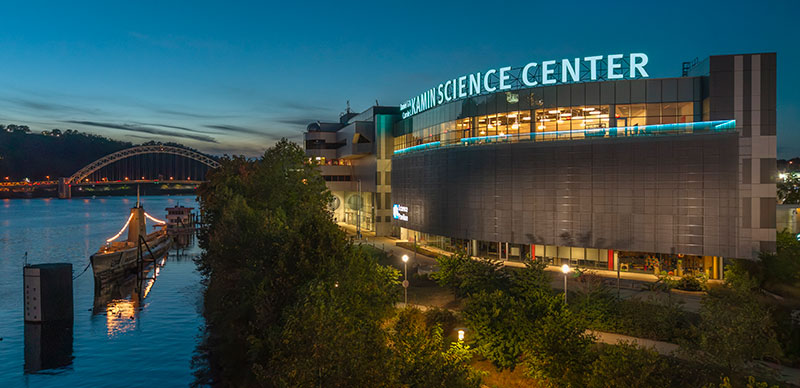
the Carnegie Science Center, SciQuest, you can experience an earthquake, get up close
to a miniature tornado, and be blown away by a full-size wind tunnel.
SciQuest consists of 28 exhibits, many of them created for the Science Center by
its staff of designers and craftsmen, as well as a number of successful exhibits purchased
from around the world.
Science Center Director Seddon Bennington says SciQuest represents “what the
public wants…it comes to grips with what they are looking for when they come to
the Science Center: hands-on, interactive learning. SciQuest does things on a scale
larger than what people are used to.”
SciQuest represents a growing trend at the Science Center-exhibits that allow visitors
to play an active role in the scientific display. This hands-on exposure makes it
easier to understand principles that are difficult to present in a classroom environment.
SciQuest team leader Dennis Bateman hopes that if a school group takes one field
trip during the school year, it will be to the Science Center, because the exhibit
is especially valuable for teachers. It offers learning opportunities not possible
in the classroom because of the size, cost and scope of the equipment involved. Designers
presented an advisory panel -nine teachers from seven different school districts in
Western Pennsylvania-a blank blueprint for the exhibit’s floor plan, and let them
choose which exhibits to incorporate. The teachers agreed on three difficult areas
to explore in the classroom: 1) the physics of flight, such as wind dynamics, 2) forces
of nature, like hurricanes and tornadoes, and 3) the science of light and sound waves,
such as fiber optics and echoes.
The approach to each topic is called a “Quest.” A class studying light
and sound waves can go on the Sound Quest, for example, and use a set of educational
materials to guide them through exhibits such as the Echo Tube, Visible Waves, and
Rock Core Xylophone. If you take the Quake Quest you visit the Quake Room, Shake Tables,
Seismographs and other earthquake-related exhibits. Teachers will be able to find
these pre-visit “starter kits” for their students online at the Carnegie
Science Center’s homepage on the World Wide Web, and can visit displays related to
the subjects they’re teaching.
The SciQuest project began one year ago, made possible by a grant from the Grable
Foundation, which supported the need to produce better educational resources for middle-schoolers-seventh
through tenth grades. While test versions of the exhibit have been up for several
months, SciQuest officially opens November 23. Here’s a look at what you’ll find:
The Physics of Flight
What keeps a plane in the air, and how can two feathers fall at the same speed?
SciQuest visitors witness the physics behind these principles first hand. The Testing
Tunnel challenges paper airplane builders to test their creations in a miniature wind
tunnel and see how well they stand up to flight. If the airflow around the wings is
uniform, the plane will be stable in flight, and if not, changing the angle of the
back of the wing will dramatically change flight direction. To experience the effect
yourself, strap on a pair of arm-length wings and step into the Wind Tunnel, a human-size
counterpart to the Testing Tunnel, and feel how and why birds change the angle of
their wings in flight. It’s one of the best ways to learn Daniel Bernoulli’s principles,
showing how the curvature on top of a wing directs airflow down, and produces lift.
More of this Italian physicist’s theories can be found at work at Bernoulli Set, a
table with three examples that illustrate ideas from his work.
Studying bird wings is an ideal way to learn more about air movement over wings.
Visitors can see cross sections of bones and feathers, or run their hands along the
Bird Wing Motion Railing, a metal walkway that will give patrons the feeling of what
it’s like to be a bird flapping its wings.
To see why that feather and coin drop at the same rate, visit Gravity Gets Me Down,
two sealed tubes with two objects in each. One tube is filled with air and the other
is in a vacuum. Because there is no air resistance in the vacuum tube, both objects
will fall at the same speed. That’s not the case in the air-filled tube (or anywhere
in the Earth’s atmosphere) because of the molecules displaced as an object falls.
The feather, because of its shape, size and weight, will be slowed down much more
than the coin.
Some of the ideas behind SciQuest are classic scientific demonstrations, such as
the beach ball floating over a mounted fan. Because of its shape, air will travel
uniformly around the surface of the ball. So even tipped at 45 degrees, the air flowing
underneath it will hold it in the air. Bateman added his own touch to the exhibit
by replacing the beachball with a giant plastic eyeball.
The Physics of Flight doesn’t have to take place in the air. Drag Race pits three
contending shapes through a green solution to see which moves most quickly: a circle,
a cube or an airfoil. The airfoil moves fastest because its aerodynamic shape creates
the least drag in the liquid to slow it down. As the exhibit points out, this shape
is the same as part of another Science Center exhibit, the bow of the U.S.S. Requin
submarine, moored just outside in the Ohio River.
Forces of Nature
It’s bound to be a SciQuest favorite-the Quake Room. Imported from a science center
in New Zealand, the five-by-seven-foot booth allows visitors to set a magnitude and
feel the tremors of a simulated earthquake. Patrons learn about plate-tectonics-the
study of how earthquakes occur because of the shifting of the plates that make up
the Earth’s crust. Seismologists, the scientists who study earthquakes, frequently
work with architects in high-risk earthquake areas like San Francisco, deciding which
building materials will lessen the disastrous effects of an earthquake. Budding seismologists
can design their own buildings at the Shake Tables, where they decide on the size,
arrangement and materials that can handle a simulated earthquake when the table becomes
an earthquake zone. San Francisco’s Transamerica building is an earthquake-resistant
structure because of its triangular shape. Some buildings can sway as much as three
feet in an earthquake. To learn more, visit the Seismic Waves computer, an interactive
tutorial that shows the global effects of a shockwave.
Tornadoes are one of nature’s most awesome natural phenomena. High- and low-pressure
winds create a vortex that can reach speeds of up to 300 miles per hour. There is
still much that remains unknown about how twisters form, in an increasing effort to
understand when and where they will strike. The Tornado Chamber is a clear cylindrical
chamber, fitted at the bottom with two humidifiers. At the top there is a cooling
fan from a personal computer. The effect is a realistic miniature tornado. By adjusting
the amount of mist in the chamber, patrons can adjust its movement and size.
Hurricanes, which often precede or accompany tornadoes, are also a SciQuest focus.
Visitors can spin a disc three feet in diameter and watch as a pearlized fluid, the
same solution found in some desktop novelty items (a mixture of fish scales and liquid
soap), spins around to form hurricane cloud formations. If you’d rather create a hurricane
in cyberspace, try the Air Pressure Computer Simulation. This computer model, written
at the Augsburg College in Minnesota, lets users manipulate weather conditions like
air pressure, moisture and wind direction, then watch as the resulting weather systems
come together.
SciQuest takes a look at the real-life effect of these phenomena. At the Video
Stack, nine television monitors show footage of natural disasters around the world
and their aftermath. SciQuest designers tried to make the exhibits as helpful to applied
science in the classroom as possible, designing each presentation so that it will
hold the interest of sixth through ninth graders.
Light and Sound Waves
The Light and Sound Waves exhibit teaches the science of what we hear and see.
White light, in the Light Mixing exhibit, is created by combining the three primary
colors. Visitors control the amounts of each color in the mixture, and see how it
influences the hue of the resulting field. The Infrared Sheet exhibit seems like high-tech
spy technology when an infrared camera captures your picture and projects it onto
a large screen, but it illustrates an important optical principle about what parts
of the light spectrum are visible to the naked eye. To see yet another part of the
spectrum, take a look at the Ultraviolet Objects exhibit and see how images look under
white and ultraviolet light.
The study of light waves has made fiber optics possible-an increasingly valuable
technology to meet new demands for faster communications and larger information resources.
Visitors see fiber optics work, and learn how the angle of light refracting on the
inside of a fiber optic tube allows a laser light to pass from one end to the other.
For music lovers, there’s the Rock-Core Xylophone, where visitors can play out
a melody with rocks. Different sized rocks will create varying tones, for a unique
sound you’re not likely to hear anywhere else. If singing is more your style, try
the Echo Tube, and learn why a sound repeats itself. Echoes are caused by sound waves
being reflected off the surface of an object, and different sized tubes create different
sounding echoes.
Since opening in 1991, the Science Center has stressed innovative exhibits like
SciQuest that give western Pennsylvania an educational advantage in learning science.
One benefit of relocating exhibits and offices to make room for SciQuest is that other
creative programs such as YouthAlive! (see the May/June 1996 Carnegie Magazine) have
more opportunity to grow.
Mark Petruzzini is the electronic editor of Carnegie Magazine.