In a minute-long movie marvel
called The Conjurer, created in 1899, French magician- turned-filmmaker George
Méliès one-upped his colleagues in the conjuring trade. He made himself literally disappear,
then he made his female assistant disappear. She turned into him. He turned into her.
She turned into confetti-all in plain sight. With this 60-second film, special effects
had found its first master.
Today’s movie magicians have graduated to making entire cities disappear, a stunt
pulled off with alarming realism in the 1996 film Independence Day, in which extraterrestrial
invaders set out to systematically destroy the world. Despite the increase in scale,
special-effects artists still rely on the same visual sleight of hand that early filmmakers
practiced. Only the technology has changed.
A unique behind-the-scenes look at how movie-makers use special effects to create
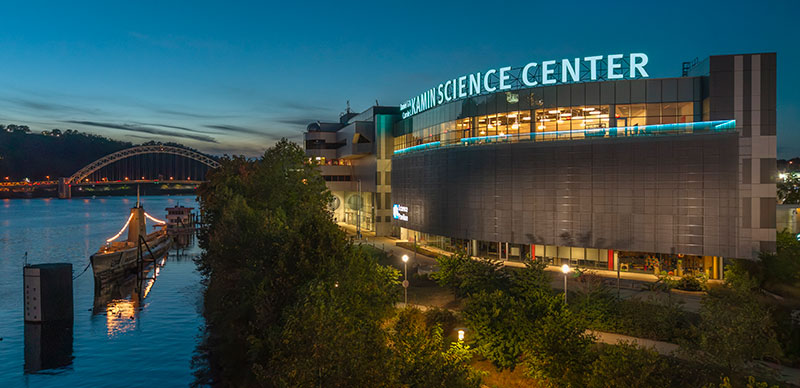
memorable, thrilling scenes is in store for viewers in a new film showing at Carnegie
Science Center’s Rangos Omnimax Theater through June 12.
Special Effects explores the method behind the magic by following the wizardry
that goes into blockbuster movies including the Star Wars Trilogy Special Edition,
Independence Day, Jumanji and Kazaam.
Carnegie Science Center is one of 18 science museums worldwide showing Special
Effects. Produced by NOVA/WGBH Boston and narrated by actor John Lithgow, the film
“celebrates 100 years of cinema and the technological achievements that have made
special effects a critical part of the entertainment industry today,” says the film’s
award-winning producer, Susanne Simpson. As executive producer of NOVA Large Format
Films, Simpson has brought to the screen To The Limit and Stormchasers,
both of which were shown at Carnegie Science Center. Special Effects was directed
by Ben Burtt, the winner of four Academy Awards for his innovative sound design on
Star Wars, E.T.: The Extraterrestrial, Raiders of the Lost Ark and Indiana
Jones and the Last Crusade.
A production of NOVA/WGBH Boston. An IMAX Experience. Starring Scenes From “STAR
WARS TRILOGY SPECIAL EDITION” With Visual Effects By Industrial Light & Magic.
“INDEPENDENCE DAY” “JUMANJI” and “KAZAAM” With a Special Appearance by KING KONG.
©1996 WGBH Educational Foundation. All Rights Reserved.
TRIVIA QUIZ
What do you know about special effects? Can you figure out the answers to the following
questions? Each one involves a scene from Special Effects, showing now at Carnegie
Science Center.
1. What special effects technique allowed Moses to lead the Israelites through
the parted waters of the Red Sea in the 1923 version of The Ten Commandments?
A. glass walls
B. animation
C. a bisected slab of Jell-O®
D. all the above
2. In the 1933 version of King Kong, close-ups
of the giant ape shows rippling motions in his fur. What is the reason for this?
A. The film was shot in a drafty studio.
B. Special-effects artists went to great pains to reproduce fine muscle movements.
C. The ripples are caused by human fingerprints.
D. static electricity
3. In 1939 the Academy Awards® established “Best Achievement in Visual Effects”
as a regular category. Which of these nominees garnered the Oscar that year?
A. Gone With the Wind, in which Atlanta goes up in flames.
B. The Rains Came, a love story in India punctuated by a series of natural disasters.
C. Union Pacific, about the building of the transcontinental railroad impeded by
spectacular train wrecks.
D. The Wizard of Oz, featuring a tornado, an emerald city, flying monkeys and a
melting witch.
4. In The Wizard of Oz, what special effects technique was used to create the tornado
that whisks Dorothy and Toto to the Land of Oz?
A. footage of an actual tornado projected onto a screen
B. a silk stocking twisted by a blowing fan
C. a 30-foot long burlap sack suspended from a truck running on an overhead track
D. all of the above
5. What space movie includes a sneaker as a substitute for a rocket ship?
A. Forbidden Planet
B. 2001: A Space Odyssey
C. Return of the Jedi
D. Apollo 13
6. At the end of Terminator 2: Judgment Day, the T-1000 cyborg is destroyed in
a vat of molten steel. What technique was used to show this sizzling denouement?
A. robotics
B. stop-motion puppetry
C. computer animation
D. all of the above
7. What up-and-coming star gets 40 seconds of screen time in The Abyss, 61/2 minutes
in Jurassic Park, 40 minutes in Casper and 77 minutes in Toy Story?
A. Tom Hanks
B. Tim Allen
C. Tyrannosaurus rex
D. Computer generated imagery (CGI)
QUIZ ANSWERS
1.C. Just before this point in the film Moses parts the Red Sea. This was accomplished
by filming water pouring down two sides of a U-shaped tank and then running the film
backwards, making the water appear to divide. Keeping the walls of water apart, however,
while the Israelites walked through, was much trickier. A slab of JELL-O was sliced
in two and filmed at close range as it jiggled. This shot was then combined with live-action
footage of the Israelites walking into the distance.
2.C. The real King Kong was an 18-inch-high puppet with a metal skeleton covered
with foam rubber and rabbit fur. A technique called “stop motion” brought him to life.
Animators posed Kong, exposed a shot, then moved him slightly and exposed another
shot. Twenty-four such shots last one second on the screen. Kong’s fur was matted
by the fingers of his animators when they handled him for each shot, and his fur appears
to ripple as a result.
3.B. The Rains Came lavishly created an earthquake, a breaking dam and flood, and
a collapsing temple.
4.D. Many movies rely on several different techniques to produce an important effect.
For example, Jurassic Park used a mix of animatronics, puppetry and computer animation
to create its famous dinosaurs. Similarly, the best-known movie twister ever-in The
Wizard of Oz-was created with actual tornado footage when shown in the far distance,
a coiling stocking when shown in the middle distance and a large burlap bag emitting
a cloud of dust when shown close up.
5.C. In what is one of the most complex special-effects sequences attempted, the
massed forces of the Rebel Fleet take on the Death Star at the end of Return of the
Jedi. Legend has it that among the hundreds of ships in the shot are a sneaker and
a few sticks of gum. Whether or not this rumor is true, it points out a key fact about
perception: that we interpret things we see indistinctly in the background when our
attention is focused elsewhere. Thus an oblong object in the distance, like a shoe,
suggests a spaceship-if there are real-looking spaceships in the foreground.
6.C. The sequence shows the T-1000 morphing into a succession of human forms that
it has assumed earlier in the movie. The realism of these transformations is made
possible by the ability of computers to take one image and systematically transform-or
morph-it into another.
7.D. Toy Story is the first feature film created entirely with “CGI,” or computer-generated
imagery. Parts of Jurassic Park and Casper have digital characters (dinosaurs and
ghosts respectively), but Toy Story has gone all the way, rendering every element
with sophisticated mathematical models. Over 800,000 hours of number crunching went
into the final film, which works out to more than a week of computer time for every
second on the screen.
In Toy Story “Sid the sadistic kid” has precisely 15,977 computer-generated hairs,
and a typical tree in the film has 10,000 leaves. Human skin is made of up to 10 separate
layers, controlling freckles, blushing, facial hair, oil layer and wrinkles. Human
characters started out as skeletal models programmed to move the way real people do;
toys had their own unique movements, with 212 animation controls needed for the character
Woody, with 58 for his mouth alone.
Special Effects (Jan/Feb 1997)
In a minute-long movie marvel called The Conjurer, created in 1899, French magician- turned-filmmaker George Méliès one-upped his colleagues in the conjuring trade. He made himself literally disappear, then he