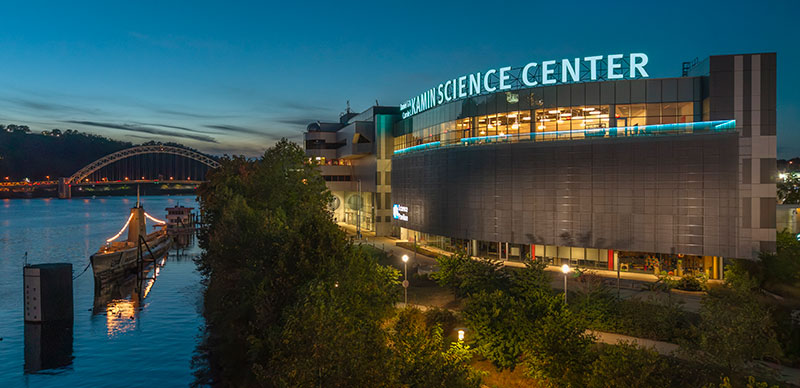
Since 1996 Carnegie Science Centers “Science
Awards for Excellence” have recognized achievements in fields relating
to science in Southwestern Pennsylvania. In recognition that it takes a
community to achieve these goals, the awards acknowledge inspirational
teaching, as well as partnerships between business, science, and education.
On March 14, 1998, Carnegie Science Center hosted a ceremony to present
the 1998 Science Awards for Excellence, and the award winners are listed
below.
But as a special benefit for Carnegie Magazine readers, the award
winners met a few days earlier at Carnegie Science Center for a panel discussion
of the ways science and education interact in our region. This rare assembly
of talented scientists and educators drew together to analyze a subject
very close to them all. The discussion leader was Terry Potter, Technical
Director for the Coatings Automotive Business Group of Bayer Corporation.
This corporation supports a number of initiatives that promote science
literacy. “Making Science Make Sense” is a major corporate effort that
includes sponsorship of a daily program on National Public Radio. The BASIC
(Bayer Scientists in the Classroom) program organizes hands-on activities,
with Bayer employees providing additional resources to local classrooms.
In addition, Bayer is a major supporter of the widespread ASSET (Allegheny
School Science Education and Technology) program in Allegheny County. Bayer
also has been a generous supporter of the Science Center.
Terry Potter set the course with a series of questions. Space does not
permit including the entire discussion, nor Terry Potters guiding commentary,
as the discussion unfolded.
— R. Jay Gangewere
Winners of the 1998 Science Awards for Excellence
Elementary Teacher: Joan M. Gorsuch, Burkett Elementary School.
Secondary Teacher Award: Sean P. Lally, Sewickley Academy.
Post-Secondary Teacher Award: George C. Bandick, Undergraduate Program
Coordinator, Chemistry, and Assistant Dean of Arts and Sciences, University
of Pittsburgh.
Catalyst Award: Jane Konrad, Executive Director, Pittsburgh Regional
Center for Science Teachers.
Entrepreneur Award: Paul L. Kornblith, M.D., founder of Precision Therapeutics,
Incorporated (PTI).
Scientist: Dr. T.E. Schlesinger, Professor and Associate Department
Head of Electrical and Computer Engineering, Carnegie Mellon University;
and Daniel D. Stancil, Professor of Electrical and Computer Engineering
and Associate Dean of Academic Affairs, Engineering, Carnegie Mellon University.
How did you get started in science?
Jane Konrad: I think I was born to it. I was always curious about science
and I was lucky to get encouragement from parents and teachers all the
way along the line. That really helped me, and is probably why I ended
up being a science teacher and being a “catalyst” between science, industry
and education. There is a need to pull together the energy from these different
levels, and bringing various people together will give you the greatest
results.
Paul Kornblith: For me there were two different early interests. I always
wanted to be a physician, particularly a surgeon, and I also wanted to
be a scientist. I grew up in Philadelphia, and Franklin Institute, the
citys science center, was a delightful place full of hands-on activities.
I think I went to Franklin Institute every weekend for about five years,
and participated in everything they did. After that it was a matter
of taking all the various steps: going through college, and medical school,
and so on. Today I think Im lucky to be here in Pittsburgh, during what
I am doing with a biomedical company.
George Bandik: I think I was not born to it. I was always very interested
in music. For years in high school I refused to take a science class, but
in the state of Pennsylvania I had to take biology to graduate. And I just
fell in love with biology because of my teacher. Today I think I am a scientist
because of the influence of that one woman. Teachers do have a very great
influence — I truly believe that.
Daniel Stancil: When I was young and people asked me what I wanted to
be, I always said I wanted to be a physicist. But I didnt exactly turn
out to be a physicist. One thing that was especially valuable to me in
my junior and senior high school years was having amateur radio as a hobby.
That called for lots of commitment to science from me in junior high school.
Joan Gorsuch: My elementary science teacher was just like the energetic
Ms. Frizzle, in the Magic School Bus series of books. You never knew what
you were going to do next, or what you would find out. She encouraged us,
and presented experiences to us, and gave us time to discover things. We
must have visited every facility in Pittsburgh. I learned to love science
from her. She was the influence on me, and I like to think I can do the
same kinds of things for my own children in the classroom now.
Ed Schlesinger: My father is a physicist, his brother is a philosopher
of science, and my mother is a mathematician. Both my parents encouraged
me in science, and I liked science fiction from the start. But my father
never gave me the easy way out if I asked questions. One of my earliest
memories is of being in the car on a trip. It was a long trip, and the
highway was very smooth. I remember asking my dad, “How do you know if
the car is moving?” My dad said that the Earth was still, so we must be
moving. Then I said, “How do you know that the Earth isnt moving, and
that we are arent standing still?” And my dad said, “We dont.” It was
typical of the way he answered all my questions. That had a lot to do with
making me want to figure things out as I grew up.
Are we doing a good
job in science education today?
George Bandik: I think were doing quite well, at least in my experience
with dealing with an awful lot of students in science classes at Pitt.
I teach 200 or 300 students a term, in honors classes and regular classes
and service classes. I think students today are better prepared in science
than they used to be. I get frustrated when people complain that todays
college students are just not as good. They want to know, they want to
learn, and they want to understand. You just have to be there to help them
do it.
David Zazac (Public Information Assistant for the Allegheny County Health
Department, and a Co-Chairperson of the Catalyst Award): I find at the
Allegheny Department of Health that students call us about everything.
They call us with specific requests such as “Can you give me the concentration
of ozone at ground level?” Teenagers call us with questions about public
health issues such as AIDS and sexually transmitted diseases. People call
us with questions about the air they breathe and the water they drink.
Its exciting for us.
Sean Lally: When it comes to teaching science, I have learned a lot
about physics, and teaching, from veteran teachers of physics. Ever since
I left college Ive been involved with the High School Physics Teachers
Association, and Ive been president of this organization for eight years.
Every school has its support groups for physics, chemistry, and biology.
I would like to see even more teachers and students at our associations
meetings. We have some 250 science teachers in our general southwestern
Pennsylvania area. Our meetings are a lot of fun and very helpful. We offer
a lot of events for students, such as Physics Amusement Park Day.
Joan Gorusch: When children come to my classes in third grade, I see
their natural curiosity. I see many parents supporting their children in
a positive way, and I disagree with the complaint that parents today are
not supporting their childrens education at school they way they used
to.
But some kids lose their curiosity about science along the way. Its
too bad. Because science is around them 24 hours a day. Its there
in the microwave in the kitchen and in their backyard. Its the elementary
teachers responsibility to capture their natural curiosity and to build
on it.
I think one reason science education begins to fall behind is that elementary
teachers are often afraid of science. When you look at undergraduate science
courses in college you see that often they do not include hands-on experiments.
You read a text — but you cannot learn science properly by reading alone.
A teachers last class in chemistry might have been in high school, at
a time when they were not as involved with science as children today. Thats
part of the problem.
But there are a lot of programs today that can bring science into the
classroom, with very delightful results. Thats why we have developed the
inquiry-based science curriculum known as ASSET, which is now used in 26
schools and 914 classrooms in Allegheny County.
George Bandik: About three years ago, at Pitt, we wiped out the undergraduate
degree in education as it used to be. Today you have to get a four-year
degree in a major and then get certified. We lost a lot of students when
we went to that program change. In chemistry, for example, the teachers
we are producing take the same chemistry courses as our pre-med students,
as our chemistry majors, and as our graduate students. I think they are
ready. But I know you can go to other colleges in our area and still get
that education degree in four years.
Joan Gorsuch: The majority of teachers working in the classrooms right
now need more support. When new science programs are introduced into the
school systems, professional development for the teachers should be part
of the program. They need to have an update on the scientific content —
things are moving so quickly.
Where does support for scientific research come from today?
Paul Kornblith: In the 1950s there was little government support of science,
and people were often prevented from seeking support from private businesses.
A program that I once directed was not allowed to seek any financial help
from business. Today that program gets 50 percent of its support from industry.
What was once absolutely prohibited is now standard, and today there is
a blend of entrepreneurship and enthusiasm for research in major companies.
If the backing is available, people have the freedom to start up their
own companies, and research that requires millions of dollars of private
funding can be supported from the private world. You cannot get that kind
of support from the government. In thirty years the situation has completely
changed and we are in a new, positive era for scientific research.
Terry Potter: I think it is interesting that most of the publicity about
technology seems to be about computers and software. People dont realize
that so much of the research being supported today is in other areas —
like the work at Applied Electro-Optics Corporation, or at Precision Therapeutics,
Inc., where Dr. Kornblith is advancing research in the study of brain cancer.
Ed Schlesinger: You see the economic impact of research in the stock
market reports. People say the “technology sector” went up, not that specific
automobile stocks went up. Scientists feel that everyone does well when
technology itself drives the Dow up — its a period of tremendous growth.
Do we need life-long learning?
Paul Kornblith: Science never stands still. Relatively speaking, the rate
of change in science is accelerating. While we used to think a science
education was good for at least four years, I think it is now about two
years because of the constant change. The ability to self-educate yourself
in your field is critical, and you have to learn to be flexible. Teachers
would be wise to show students how to learn throughout life, as opposed
to giving them information to learn. People now may change jobs several
times in their lives, and they need to know how one goes about learning.
Joan Gorsuch: Children have to see the science at work in their lives.
How many children look at their pediatrician as a scientist? What about
the nurse who weighs them or takes their temperture? Science needs to become
more of a living force in everyones life. We need to see real people sharing
their knowledge with children, and not regard knowledge as simply the responsibility
of the school teacher. Businesses can be more helpful here.
George Bandik: I think that is the weak link. Two years ago when we
were doing a quality control study for our science program I called several
industries in the Pittsburgh area and asked if they could send someone
to come and talk to me. They said they didnt have the time. “You
teach them, and we will hire them” was one response I got. The teachers
in Pittsburgh need stronger ties to the business community, a better way
of getting feedback from the workplace.
What is “Scientific Literacy”?
Sean Lally: To me it means someone who can make well-informed decisions.
Someone who knows the difference between science and pseudo-science. Someone
who can make a confident choice, whether it is in buying a product or evaluating
a commercial on television. Someone who can recognize bunk. Its a little
scary right now, when you have multimillion-dollar companies giving scientific
information to the public.
Imagine a person who invests a huge amount of money in the lottery.
Does this person have any knowledge about the statistical probabilities
of winning? I remember I had a professor who once said to a student, “You
dont know the difference between a proton and a crouton.”
Ed Schlesinger: I think that a certain type of scientific information
is simple. Suppose we were to discover that there is mercury in the Monongahela
River. We can test for that. But then you ask, does this matter? Some people
might say it has “always” been there, and so it is natural for it to be
there. But others might say it has always been bad environmentally, as
a chemical element in the river. So how much money, if any, should we spend
to clean it up? These are the sorts of decisions people have to make, but
they cannot make an informed decision based on simple scientific data,
without understanding what the data mean.
Daniel Stancil: I would add that there is another element to scientific
literacy. There is an element of passion to crack open a problem
and find the answer. We all talked about this when we discussed why we
got interested in science. There are sound reasons why you should learn
about science, but that is not what motivated most of us as young people
to go into science.
Special thanks to the students from the Court Reporting Program at the
Community College of Allegheny County for providing a transcript of the
round table discussion.
Student Award Winners and Presenting Sponsors of the 1998 Science Awards
for Excellence
Students: These awards are presented to the overall winners of the Pittsburgh
Regional Science and Engineering Fair.
Stacy Ivol, Junior Division. Stacey is an eighth grade student at Independence
Middle School and won the award for her life sciences project. Jennifer
S. Yip, Senior Division. Jennifer is a senior at Fox Chapel Area High School
and won for her project in biology.
Presenting Sponsors: Adtranz, Alcoa Foundation, Aristech Chemical Corporation,
Bayer Corporation, Ben Franklin Technology Center of Western Pennsylvania,
Cutler-Hammer, Duquesne Light, Fisher Scientific, Highmark Blue Cross Blue
Shield, Kennametal, Inc., PPG Industries, Inc., Sony Technology Center-Pittsburgh,
UPMC Health System, Union Switch & Signal Inc., Westinghouse Foundation.
Contents
Highlights
Calendar
Back Issues
Museums
Copyright 1998 Carnegie Magazine
All rights reserved.
Email: carnegiemag@carnegiemuseums.org