My focus was on a need I saw in myself and in Pittsburgh
to bring young vocal talent to people who wouldn’t ordinarily experience
it, and to provide young singers with an opportunity to perform,” wrote
Arlette Buckley, when she received the Third Annual Carnegie Centennial
Award for Music. Arlette, a 21-year-old music student at Carnegie Mellon
University, created an outreach project to provide musical programs to
nursing homes and assisted care facilities. Half of the CMU School of Music
voice majors, and some piano majors, volunteered for Buckley’s project.
She trained and inspired younger students to continue the project after
her own graduation, and was nominated by CMU for her service to the public
and her impact upon other students.
This self-motivation and initiative mark each of the 1998 award winners.
Each awardee volunteered long hours and worked energetically to share a
love of art, or literature, or science or music with others. These are
the four disciplines upon which Andrew Carnegie founded his Carnegie Institute
and Library, and are the basis upon which young people between the ages
of 15 and 25 in Allegheny County are honored by the Centennial Award Committee.
Nancy L. Rackoff, co-chair of the committee, says they “look for young
people who have seen a need in their community and responded to that need
with creativity and leadership
without any thought for reward or recognition.”
The awards were begun in 1995 when Carnegie Institute and Library celebrated
their centennial anniversary.
In science, Karrielee Noterman, age 17, inspired others by her
volunteer work at the National Aviary in Pittsburgh. Her devotion to ornithology
influenced thousands of people during her three years as an interpreter
and presenter of conservation and environmental issues. She faithfully
volunteered during weekends and summer breaks, handling the insects and
rodents that make up the diets of birds, and telling children about the
harmful effects of plastic rings from pop cans on wildlife. She motivated
people to take an active interest in the survival of rare species, like
the Bali Myrnah, a bird so endangered that more of them live in institutions
than in the wild. When a Snowy Owl escaped its lodging, Karrielee sat for
six hours in the park outside the National Aviary watching the bird’s actions
on a nearby rooftop, and she was instrumental in its safe recapture. Her
nomination by the Aviary pointed out how important her example and teachings
are to the next generation of ornithologists, many of whom will remember
how a young volunteer at the National Aviary took so much time to talk
to them when they themselves were just getting started.
Emily Kaleida of Oakland Catholic High School brought literature
into people’s lives through volunteering at the Radio Information Service
on Pittsburgh’s South Side, a service for the blind and visually handicapped.
Seventeen-year-old Emily works on the station’s database, its mailings,
and its fund raising efforts. An excellent student at Oakland Catholic
High School, she reads to a blind student at school, and takes blind neighbors
to Mass, and she volunteers to speak at the Girls Club. She was nominated
by Oakland Catholic High School, which noted “her sweet character and unassuming
demeanor” and yet how “By acting upon her values she has positively impacted
the community and our school.”
Paola Cabal, a 22-year-old artist and student at Carnegie Mellon
University, showed remarkable determination in creating a mural on the
outside wall of the United Cerebral Palsy Center for Personal Development
in Oakland. She recruited friends, students and curious passersby (of whom
there were many) to advance the painting, and worked diligently to prove,
in the words of the nominating statement, “that hope and beauty can be
evoked in something as unassuming and simple as a concrete wall.” The mural,
“Shadowtracings,” reveals the shadows cast by trees along the Centre Avenue
side of the building. “What I am doing by tracing these shadows onto the
wall is making a permanent record of the progress these trees have made
so far in their growth,” said Paola. After cleaning a large graffiti-covered
wall, she created in its place a public source of visual encouragement
for people with physical or developmental disabilities. Her project has
been the source of many opportunities for interaction between the community
and the staff of United Cerebral Palsy, which nominated her.
Winners of the Carnegie Centennial Award receive a $250 cash award,
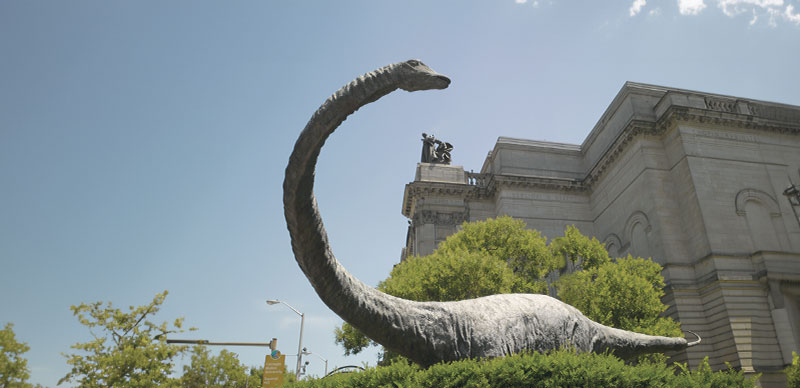
a lifetime pass to Carnegie Museums, and a replica of the appropriate sculpture
outside the museum, representing their discipline. The nominating organizations
also receive a $250 cash award and their choice of an educational resource
or program to attend. Unlike awards to young people for athletic skill
or academic distinction, the Carnegie Centennial Awards awards honor community
service in the arts and sciences, which Andrew Carnegie considered most
important.
R. Jay Gangewere
Contents
Highlights
Calendar
Back Issues
Museums
Copyright 1998 Carnegie Magazine
All rights reserved.
Email: carnegiemag@carnegiemuseums.org