Home
Museums
Back Issues
Membership
Whistler, ca. 1860
Photo credit: Modern gelatin silver print, Charles Lang Freer Papers,
Freer Gallery of Art Archives, Smithsonian Institution
Whistler: Impressions of an American AbroadEtchings and Lithographs
from Carnegie Museum of Art, Through January 23, 2000, Works on Paper Gallery
James Abbott McNeill Whistler never chose the
easy path. An artistic genius seldom satisfied with what he produced
or with the publics reaction to it, Whistler pushed the limits of his
own abilities and the limits of what his viewers would tolerate.
Born in Lowell, Massachusetts, in 1834, Whistler later claimed that his
true birthplace was Baltimore. He had the heart of a Southerner and the
intellectual sophistication of the European avant garde and his accent
and his manners sometimes seemed English, sometimes French, depending upon
whom he was with. After moving to Paris in 1855, he never came back
to the United States.
Whistlers strong sense of artistic mission was challenged in 1877,
when noted art critic John Ruskin viciously attacked Whistlers painting
Nocturne in Black and Gold: The Falling Rocket. Whistler sued
Ruskin for libel. The November 1878 trial turned into a public debate
on the nature of art, with Whistler lecturing the public on how art “should
stand alone, and appeal to the artistic sense of eye or ear, without confounding
this with emotions entirely foreign to it. . . .”
Whistler won the trial, but was paid only one farthing in damages.
His legal expenses were not covered. This experience, coupled with
his own extravagance and pursuit by a vengeful creditor, left him bankrupt
and homeless. Thus when the Fine Art Society in London commissioned
twelve etchings of Venice, to be completed in three months, he was very
happy to accept. Fourteen months later, Whistler returned to London
with about fifty etchings, one hundred pastels, seven paintings some
of the most innovative work he had ever done. True to his nature,
however, he had avoided the main tourist route along the Grand Canal with
its well-documented scenes, drawing instead on the backwater canals, crumbling
palazzos, and the life of a living city no other major artist had noticed.
The Carnegie International Portrait of a Century
Andrew Carnegies plan to enrich the permanent collection of Carnegie Museum
of Art through regular international exhibitions has, we can safely say,
been a success. More than 300 works have entered the museums collection
through the Carnegie International, making the collections core, as intended,
the “Old Masters of tomorrow.”
The Carnegie International is a great document, a visual history still
being written of our cultural evolution. Each exhibition is part of a dialogue
with the preceding ones, reflecting the social concerns, political upheavals,
aesthetic breakthroughs, and general consciousness of the world as a whole
and the generation that it represents. Madeleine Grynsztejn, curator of
contemporary art at Carnegie Museum of Art and of the 1999 Carnegie International,
says that our current era is “characterized by the many voices allowed,
since the 1960s, in the conversation we call culture.”
The earliest Internationals stuck closely to the traditions of academic
art and purchases of Winslow Homers The Wreck, for example, reflected
the museums aesthetic caution. Politics affected the practical aspects
of mounting the exhibition: during World War I, there were no exhibitions,
and during World War II the exhibitions were solely of American painting
because shipping art from Europe was too dangerous. Few works were
purchased by the museum during the depression. Another tradition
that gave way during European upheavals was hanging the exhibition by country.
But the influence of politics goes deeper than such practical matters.
In the exhibition history International Encounters, Lois Marie Fink writes,
“After 1914 . . . the general expectation that humankind would move steadily
onward and upward toward perfection and harmony lost all credibility as
the Western world, like Western art, became ever more fragmented.”
As the established order of the previous century gave way, the art in the
International began to reflect the turmoil. The largely figurative works
purchased throughout the 20s, 30s, and 40s indicate that Pittsburgh was
not ready for the abstraction of the 1950s.
In the 1950s and 60s, the permanent collection began to grow more quickly,
a reflection of the citys revitalization during Renaissance I, more reliable
funding, and a commitment from the community to support the institution.
During the 1980s, with a reaffirmation of Carnegies original goals
for the show, and a new focus on international art, the International was
reinvigorated. In 1988, more women were included on the advisory
committee, and more female artists were featured in the exhibition.
The 1991 exhibition was co-curated by a woman for the first time, and
the 1999 exhibitions curator is a woman. New voices are now part
of the conversation. The Internet, global migration, and cross-cultural
influences and a millenial consciousness should certainly influence the
upcoming chapter in this great cultural document.
The 1999 Carnegie International opens November 6. What will we think
when we see our times reflected in it? And what will history say
about us, when it sees this International as the final statement of the
20th century?
The 1999 Carnegie International is sponsored by Mellon Bank Corporation.
Major support is provided by income from the A. W. Mellon Educational
and Charitable Trust Endowment Fund, and by The Grable Foundation; The
Heinz Endowments; the National Endowment for the Arts; the Pennsylvania
Council on the Arts; USAirways; and The Andy Warhol Foundation for the
Visual Arts.
Additional support has been received from ArtPace, A Foundation for
Contemporary Art / San Antonio; Susan and Lewis Manilow; the Mondrian Foundation;
and the Trust for Mutual Understanding.
The exhibition program at Carnegie Museum of Art is supported by grants
from The Heinz Endowments and the Pennsylvania Council on the Arts. The
programs of the Heinz Architectural Center are made possible by the generous
support of the Drue Heinz Trust.
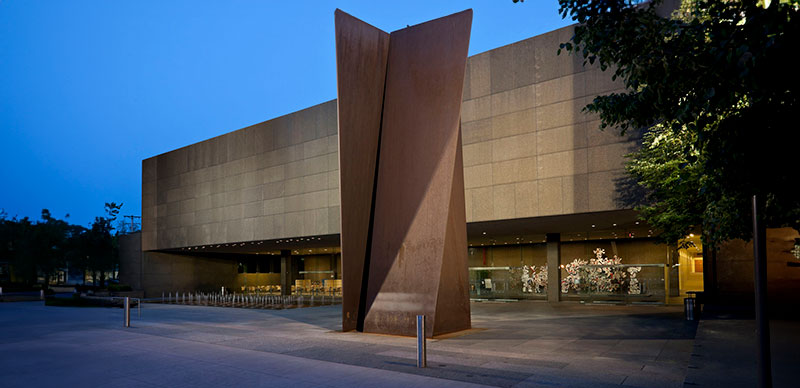
Richard Serra’s Carnegie won the 1985 exhibition with his monumental
steel sculpture Carnegie, a gift of Jane Holt Roesch, stands at
the Forbes Avenue entry.
Credit: Tom Barr
Home
Museums
Back Issues
Membership
Copyright (c) 1999 CARNEGIE magazine
All rights reserved.
E-mail: carnegiemag@carnegiemuseums.org