Home
Museums
Back Issues
Membership
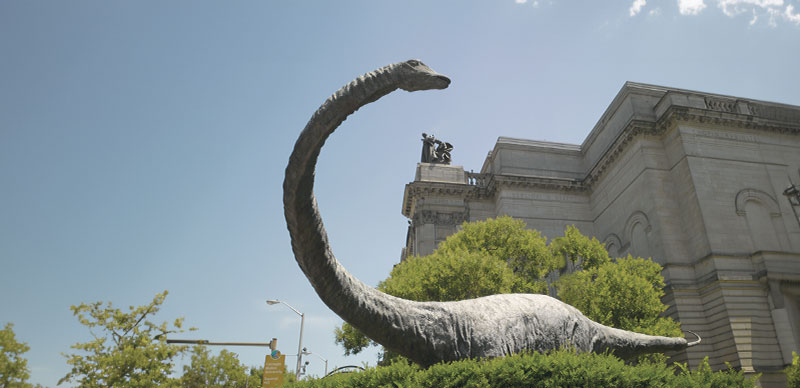
Reconstruction by Mark Klingler
By Tina Calabro
Carnegie scientists prove that Darwin got it right
Evolution is based on authentic evidence of how life on the Earth
works, say Jay Apt, Mary Dawson, and John Wible of the Carnegie Museum
of Natural History. They point to recent discoveries that support Darwin’s
theories, and note that visitors were entranced with the recent museum
display of feathered dinosaurs, which clearly bridged the gap between modern
birds and dinosaurs of long ago.
Adapted from an article published in the Pittsburgh Post-Gazette, Sunday,
September 26, 1999.
In the 141 years since the publication of Charles Darwins Origin of
the Species, scientists have used new data to become even more convinced
of Darwins observations. The last scientific objection to the rules Darwin
deduced was overcome a hundred years ago when Marie Curie discovered radioactivity.
The radioactive elements in Earths interior kept the planet from cooling
off in a few million years, and allowed us to estimate its age as over
4 billion years, time enough for life to evolve.
New information appears constantly: last year paleontologists revealed
the latest example of a fossil animal intermediate in the progression from
dinosaurs to birds in Nature (September 16, 1999), and also in National
Geographic (October 1999). But revivals of hundred-year-old debates also
appear constantly, generally without consideration of the scientific discoveries
of Darwins time or of ours. In 1999, the Kansas Board of Education decided
to delete the teaching of evolution from the state’s science curriculum.
Locally, journalist Jack Kelly of the Pittsburgh Post-Gazette (September
19, 1999) wrote that the fossil record does not support evolution. Nothing
could be further removed from the facts.
Millions of fossils, found in well-dated sequences of rocks, show evolution
of forms through time and show many transitions among species. Charles
Darwin began in 1831 to assemble a huge body of evidence that he analyzed
and evaluated for more than 25 years before he carefully deduced a new
rule of descent of organisms with modification. The rules of evolution
and natural selection have been observed to apply to viruses within a few
hours, to reptiles on islands changed by a hurricane over a few months,
to fish in isolated ponds over a few years, and to horses over millions
of years.
The fossil record is unequivocal on the progression of life from simple
beginnings to complex organisms. Animals without backbones predate vertebrates.
Amphibians appear after fish, mammals appear after reptiles, and no complex
life occurs in rocks nearly as old as those containing the oldest fossil
bacteria. There is a vast body of fossil confirmation of evolution and
of natural selection preserved in the worlds great collections, including
those of Carnegie Museum of Natural History.
To discard this vast body of authentic evidence as not worthy of being
taught in Kansas public schools is to deny those youngsters access to a
comprehensive understanding of the past. It is also to deny them future
job opportunities in the fast-growing medical and biotechnology fields,
which cope daily with evolution of viruses, natural selection of bacteria
which make them resistant to drugs, and the re-emergence of evolved, drug-resistant
tuberculosis.
In the past few years, Carnegie Museum of Natural History paleontologists
have published new information on the gradual, transitional changes of
marine organisms called brachiopods, which can be found in the rocks underlying
Pittsburgh; transitional stages in the skulls and skeletons of early mammals,
which 120 million years ago had the first beginnings of characteristics
now shared by placental mammals, including humans; evolution of whales
from early land dwellers to advanced marine animals that navigate by echolocation;
and the first evidence from China of the lineage leading from lemur-like
primates to the anthropoids, early ancestors of humans. What an adventure!
In 1999, Carnegies paleontologists worked in Wyoming, Montana, Germany,
and China, adding newly discovered animals to a vast body of paleontological
data. This same year paleontological investigation in China unearthed a
new species of the feathered dinosaur Sinornithosaurus millenii, eliminating
the distinctions between two major groups of vertebrates–reptiles and
birds. Children already know that the closest things to dinosaurs that
exist today come to our bird feeders in the winter.
Understanding the fossil record produces awe at the magnificent unfolding
of life through the immense sweep of the Earths past, an appreciation
for the present, and certainty of continuing change in the future. This
is indeed a wonderful universe for our children to marvel at and understand!
Home
Museums
Back Issues
Membership
Copyright (c) 2000 CARNEGIE magazine
All rights reserved.
E-mail: carnegiemag@carnegiemuseums.org