Home
Museums
Back Issues
Membership
by Ellen S. Wilson
“We encourage visitors to go on and have
fun, and sometimes they get a little wild and crazy. But you have to get
them to participate so that theyll learn.”
Tom Flaherty
This is a busy year at
Carnegie Science Center a new look, new exhibits, new shows, and all
of it designed solely to give visitors a better experience. In fact, this
is a great time to go. Now, however, it is the first cold month of 2000,
and jumping ahead to March and April isnt easy. This being a Science Center,
however, where imagination and some good power cables make so much possible,
my children, George and Olivia, will join me on a virtual tour that will
give some hint of what lies ahead.
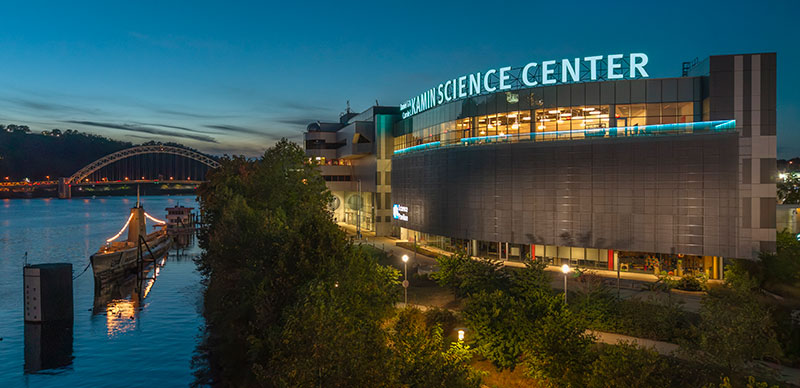
The first big change will be how the Science Center
looks on the outside.
“Everybody
sees this great building and they dont know what it is,” says the Science
Centers Tom Flaherty. “So were changing that.”
During the day, big, bright banners will identify
Carnegie Science Center to travelers on Rt. 65, the West End Bridge, and
the Fort Pitt Bridge. At night, the new look is even more dramatic. By
the end of May, an 80-foot sculpture, a vortex-shaped whirl of lights,
should be installed atop the Omnimax Theater, drawing the eye from anyone
in downtown Pittsburgh and beyond. New dots of light on the sidewalk will
sparkle with different colors, and the see-through railings on the new
stairs from the lower parking lot will be similarly illuminated with fiber
optic cables. While the children wont care about the newly resurfaced
parking lot or other basic improvements, they will be sure to notice this
sparkly little touch.
George, 7, and Olivia, 5, tear into the lobby
in their customary way and head over to the fountain, where a new interactive
laser beam lets you stop the flow of an arching jet of water without getting
your hands wet. This will keep them entertained while I pick up tickets
at the membership desk. The line for non-members also moves quickly now
because of a newly simplified price list. For one sum, general admission
includes all exhibits, the submarine, and the planetarium. Omnimax admission
is extra.
Tom, a specialist in electronics and Director
of Exhibits and Facilities since 1994, is joining us on our imaginary springtime
visit, and he doesnt bat an eye at the exuberance with which George and
Olivia attack the exhibits. “We encourage visitors to go on and have fun,”
he says, “And sometimes they get a little wild and crazy. But you have
to get them to participate so that theyll learn.” Every exhibit goes through
five stages, from initial idea, to proposal, development of goals, design,
and operation. Rigorous reviews and testing insure that there are no sharp
edges, that everything is accessible, and that even with heavy use the
things keep working day after day.
“Ive looked at a lot of other exhibits at other
science centers, and ours are better,” Tom says. “They last longer. I think
our fabricators are some of the most talented craftspeople on the planet.
Their work is truly exceptional, and we try to make as many of the exhibits
here as possible.”
Thus reassured that my kids can do no damage,
I release them into the irresistible appeal of SciQuest, a landmark exhibit
that changed the way the Science Center works. Tom and the Exhibit Design
team have upgraded the components and text panels in this space over the
past three years, and it remains the first stop for many visitors. We always
bat the floating eyeball around and whisper through the echo tube before
doing anything else.
On we go, skipping (the kids, anyway) up the ramp
past the new marquee over the Science Stage, and around the atrium, soon
to be the site of a cool new mobile that takes advantage of its 65-foot
height. A beautiful addition to the space, the mobile will also reveal
the movement of air currents.
Arriving on the fourth floor, George and Olivia
head for their new favorite place, Exploration Station (see January/February
2000 CARNEGIE magazine). This area alone, with its water tables, chick
hatchery, construction projects and more, could keep me and the kids entertained
well past the point of exhaustion. Our current visit being imaginary, however,
we still have plenty of time to go back down to the third floor and have
a seat in the brand new Kitchen Theater. Rebuilt to hold 75 people, twice
its former size, and redesigned with a diner theme, the theater is in its
own separate space now, which gives the presenters better control over
noise and lighting.
I rest my feet and watch the kids help prepare
liquid nitrogen ice cream before we leave the theater and walk into the
underwater world of Sea Scape. The three aquariums in the coral reef exhibit
have been augmented by a fourth, containing a mangrove tree that juts out
a few feet over the atrium and heads up to the skylight. In tropical areas,
mangroves provide a breeding area for coastal fish, and there is almost
always something interesting to watch in this new tank.
The original tanks have also been enhanced, with
eight cameras that zoom in on underwater life, computer kiosks that give
in-depth information about the contents of the tanks, and a video microscope
with fixed slides projected onto a large monitor. If a staff member is
present (and there usually is), they will present live slides of coral
specimens, leaves, or algae. Pictures over the tanks orient visitors to
their location in the seascape and show how this ecosystem fits together.
A new, supervised touch tank will contain mainly invertebrates and provide
yet another opportunity for small visitors to get wet while they explore
the wonders of nature.
More watery activities include a refurbished yellow
submarine and a chance to see the world through the eyes of a fish. This
sea-like atmosphere will owe a lot to students from the Art Institute of
Pittsburgh, who were given a class assignment to develop the environment
and will log 1000 hours in the science center workshop over the spring
and summer to make it happen.
Adults may be wearing down at this point, but
the energy stores of seven and five year olds are vast. We amble down the
ramp (hey! new carpet!) to the second level and stop in to see an old friend,
the Miniature Railroad and Village. Initially, nothing looks different.
Thats because you dont see the new computer system running things. You
dont see the people who have gained access to the trains via the Internet
and are now watching them whiz around the tracks from home. If Science
Center designers and Opto 22, the company working on the new interactive
website, have their way, tiny cameras will be mounted on the trains so
that you feel like you are actually riding them.
After the railroad, we are ready for a different
kind of transportation, and take our seats in Buhl Planetarium to see “New
Cosmos,” which opens April 8. John Radzilowicz, Director of the Planetarium
and Observatory, explains that this show is about advances in astronomy
and space exploration over the past 100 years. “Circus of the Stars” is
also a favorite show, and well be back for that another time.
Finally, we cant resist checking out some of
the components of the upcoming ZAP Surgery, the Science Centers newest
traveling exhibit. The latest in non-invasive surgical techniques such
as endoscopy, cryosurgery, laser surgery and gamma knife surgery are featured
in this exhibit, which opens at the Science Center in February 2001. In
the meantime, visitors can have a look at various pieces of the exhibit
between April and June when they are set up on the second floor for testing.
It is way past lunchtime, but well check out
the River View Café anyway, and have a little something. New signs
and a new layout make this area easier to navigate, and take advantage
of the views of the river. Tom points out that the staff are continually
looking for ways to improve a visit to the Science Center.
As we thank Tom and head to the car, I notice
that the kids seem revved up, rather than exhausted. This is how a museum
should work, I think, not wearing you out, but inspiring you and opening
up new possibilities. George and Olivia have done all they can possibly
do for one day, but rather than being drained, their little batteries are
charged and ready for whatever lies ahead.
Ellen S. Wilson is a frequent contributor to
CARNEGIE magazine.
Home
Museums
Back Issues
Membership
Copyright (c) 2000 CARNEGIE magazine
All rights reserved.
E-mail: carnegiemag@carnegiemuseums.org