Click here to connect the Andy Warhol
Archives web site.By John Smith
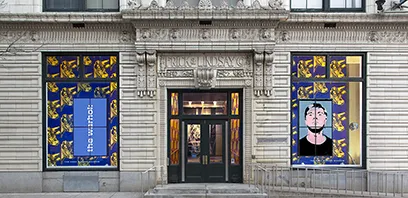
After its opening in May 1994, the Archives of The Andy Warhol Museum quickly took
its place among the important research collections within Carnegie Institute. The
archives staff responds to nearly 500 research requests each year, a figure we are
confident will continue to increase.
The archival collections are an unparalleled resource for scholars and researchers
studying Warhol’s life and art; however, because Warhol’s interests were so wide-ranging
and his sphere of influence so far- reaching, the collections have also proven valuable
to researchers working in areas such as gender studies, avant-garde film, performance
art, and popular music. Recent visitors to the archives reveal the key role the archives
are playing in furthering our research into Warhol and his times.
Two of the Archives’ most dedicated users are Neil Prinz and Callie Angell. Prinz
in collaboration with art historian Georg Frei, is compiling the catalogue raisonné
of Warhol’s painting, sculpture and drawings. The project is taking place under the
auspices of The Andy Warhol Foundation for the Visual Arts and Thomas Amman Fine Art,
a Swiss gallery with a long history of involvement with Warhol’s works. During his
frequent visits to Pittsburgh, Prinz has uncovered countless details about Warhol’s
work that have proven essential in dating Warhol’s paintings, establishing exhibition
histories, clarifying questions concerning his working methods and materials, and
offering leads to previously undocumented works by the artist.
Angell, who spearheads the Andy Warhol Film Project at the Whitney Museum of American
Art in New York, is engaged in cataloguing and preserving the more than 500,000 feet
of motion picture film created by Warhol from 1963 through the early 1970s. During
a recent week-long research visit in Pittsburgh, Angell discovered a notebook that
Warhol had filled with ideas for films he wanted to make.
“The very existence of such a notebook contradicts previous assumptions about Warhol’s
indifferent approach to filmmaking and confirms other recently discovered evidence
of his systematic working methods,” Angell notes. Another discovery was a 15-page
financial report from the Filmmakers Cooperative for the distribution of the Warhol
films. Angell says this document “could not be duplicated in twenty years of independent
research. With the discovery of this single document, a major part of the puzzle has
been filled in.”
Researchers engaged in shorter-term projects also visit frequently. Melissa Ragona,
who teaches at State University of New York, Buffalo, visited the Archives to listen
to rare taped interviews between Warhol and the German filmmaker Leni Riefenstahl
for her upcoming publication, A Genealogy of Spectacle: Fascism, Consumerism, and
the Mimetic Body. Warhol interviewed the reclusive Riefenstahl in 1975 for Interview
magazine. The archival collection contains more than 3,500 audio tapes, many containing
the original material used in Interview.
In the fall of 1996, the Archives were used extensively by a group of University
of Pittsburgh graduate students enrolled in a seminar about Warhol. Their professor,
Kirk Savage, recognized the importance of the Archives and encouraged his students
to make use of the collection. For many, it was their first opportunity to use primary
research materials, and while the sheer volume of material sometimes overwhelmed them,
they nevertheless were able to produce interesting, challenging work based on their
discoveries.
The Archives Study Center, located on the third floor of The Andy Warhol Museum,
is open to researchers by appointment only, during regular museum hours. Call 237-8360
to schedule a visit.
John Smith is the archivist at The Andy Warhol Museum.
Working in the Warhol Archives (Jan/Feb 1997)
Click here to connect the Andy Warhol Archives web site.By John Smith After its opening in May 1994, the Archives of The Andy Warhol Museum quickly took its place among