By Mark Petruzzini
The mentors from Oliver High School — picked for their leadership qualities and
academic achievement.
At 3:00 p.m. it’s snack time for 12 children at Carnegie Science Center, marked
by the crackling of pretzel wrappers, the chewing of fruity snacks, and the sipping
of a tangy vintage grape juice. These young people seated around folding tables are
second graders from the North Side’s Martin Luther King, Jr. Elementary School, and
are part of a science enrichment program called YouthALIVE!. After 15 minutes of food,
drink and a word search puzzle (Delmar Kirk found all 16 words), the kids start their
lesson. Today, they’re reading about bats — everything from the long-eared kind and
the wrinkled-nosed- variety to the microbat — so small, it could fit in the palm of
a second grader’s hand. Some students make drawings, while others read aloud to their
classmates stories about their favorite winged creatures.
One thing that makes YouthALIVE! unique is that the teachers — called mentors — are
all high school students from Oliver High School, also on the North Side. The mentors
are hand-picked for scholastic achievement and leadership qualities. The current group
of 12 mentors call themselves the ACT TEAM 2000, or “Active, Creative, Teenager, Educating,
Achieving Mentors,” and “2000” is their symbol for the future. For this group of second
graders, there are three mentors: Ashanti, Danielle and Sarah. Ashanti is reading
a bat book with Erik, Ashley, Christopher and Delmar. Erik is outspoken, in contrast
to his mentor, who is a little shy. Bernadette Yandel, a first-grade teacher who comes
in to help supervise, thinks the two make a good combination, remarking, “You can
tell working with the kids is helping Ashanti come out of her shell, and it’s good
for Erik to see a role model.”
Four days a week, different mentors from the ACT TEAM 2000 teach youngsters from
second through eighth grades everything from how bats “see” using sonar to how the
space shuttle goes into outer space. Next week, the second graders’ agenda will include
making bat puppets and putting on a skit to demonstrate the things they’ve learned.
Claire Spampinato, a presenter in the Kitchen Theater and a supervisor for the program,
thinks YouthALIVE! does more than teach science. “I think a really important part
of the program is the relationships the kids make with each other,” she says. “The
younger ones see a successful role model they can look up to. For most of the mentors,
it’s their first job, and they’re learning how to take on the responsibility of working
with kids.”
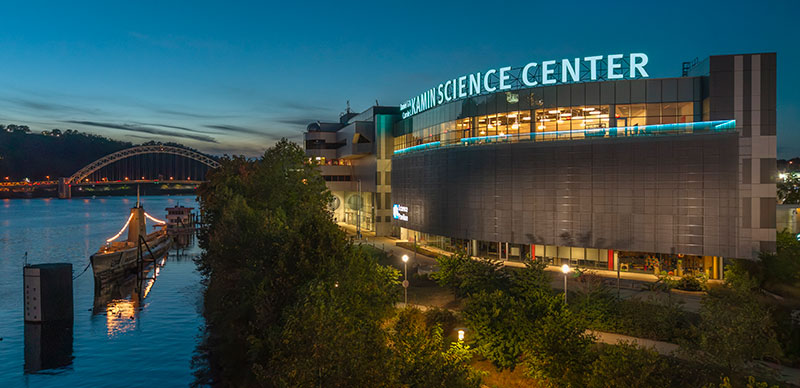
YouthALIVE! is part of Carnegie Science Center’s community outreach effort. As
with its other programs, the Science Center hopes to instill a sense of ownership
among its North Side neighbors, thus breaking down any barriers in thinking that the
Science Center is for “someone else.” Physical barriers are eliminated as well by
actually busing the students to and from the Science Center.
Working with an urban school system, YouthALIVE! has made rapid steps in reaching
many students. In two years, the number of students involved has nearly doubled, now
reaching some 78 children. Catherine Musser, educational coordinator for the Science
Center and director of the YouthALIVE! project, began the program in September 1994.
YouthALIVE! is a national initiative of the DeWitt Wallace-Reader’s Digest Fund in
partnership with the Association of Science-Technology Centers, and Allegheny General
Hospital.
Musser also heads the Overnighter Program, in which children and parents can spend
the night in sleeping bags on the Science Center floor, and participate in a wide
variety of events including workshops, and shows at the Omnimax and planetarium. For
the Science Center, these programs are a way of giving back to its North Side neighbors,
and of inspiring generations of potential young scientists in a community where educational
resources are in high demand. Musser would like to see endowments continue to support
programs like YouthALIVE!, which would permit the Science Center to continue growing
in the scope of its educational programs. Science Center staff already includes 12
educational coordinators, like Musser, who reach over 165,000, young and old, in Pittsburgh
and western Pennsylvania.
In many ways, older, successful role models give younger children an inspiration
to achieve academically. The program does not seek out top achievers among the grade-schoolers,
but rather, it pursues students who could use help acquiring the skills essential
to success.
Each group of students has a special project. Second graders will construct a replica
of a bat cave that can go on display in the Science Center’s main lobby. Middle-school
students spend part of their time with the Pittsburgh Children’s Museum and part with
the Science Center. This spring they will take a trip to the Challenger Space Center
in Wheeling, West Virginia, where they will see what it’s like to be a part of a mission
into outer space.
What do second graders think about all of this? “I like coming to the Science Center,”
says Marcus Simpson, “and I like the trips we take.” When asked about their favorite
part of YouthALIVE!, the high school-age mentors’ responses are all the same, “Working
with the kids!”
It’s 5:00 p.m. now and the second graders start to pick up their coats. They line
up outside the classroom and are hushed by their teacher. They seem a little sad as
they climb into the yellow bus — two hours have gone by all too quickly. They were fascinated
by the Science Center and enlivened by their studies. Next Tuesday, YouthALIVE! will
bring them back.
Mark Petruzzini is a professional writing major at Carnegie Mellon University
and the electronic editor of Carnegie Magazine.
YouthALIVE! At Carnegie Science Center (May/Jun 1996)
By Mark Petruzzini The mentors from Oliver High School — picked for their leadership qualities and academic achievement. At 3:00 p.m. it’s snack time for 12 children at Carnegie Science